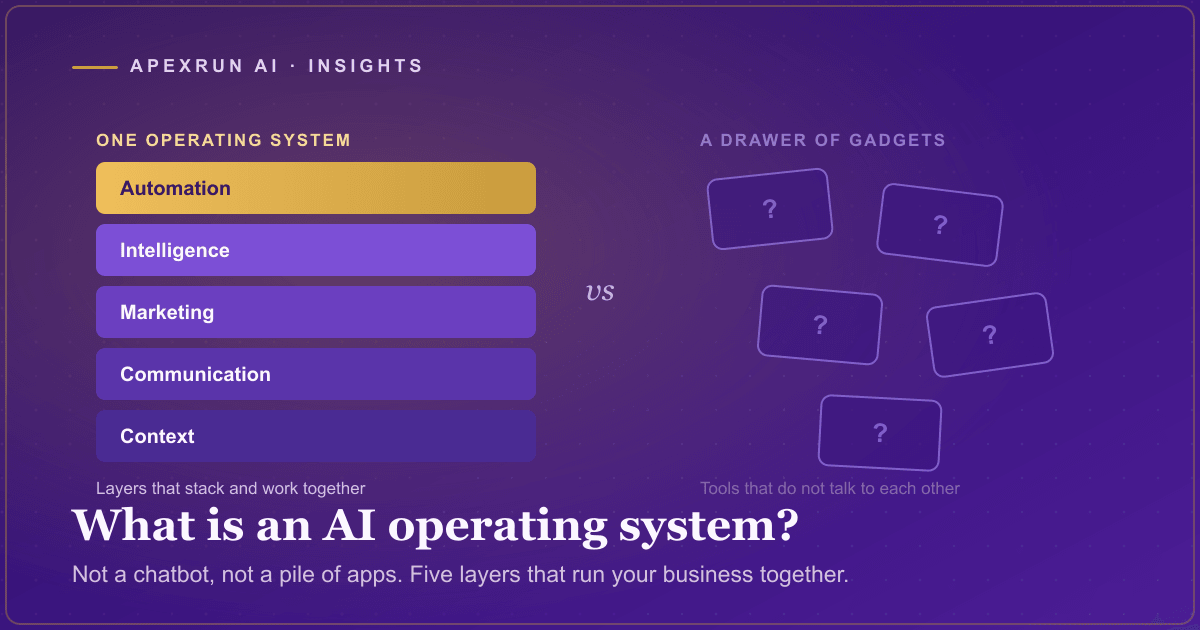
The phrase gets thrown around loosely, so let me answer the question directly. What is an AI operating system? It is the software layer that runs the recurring work of your business the way a computer’s operating system runs the machine: quietly, in the background, coordinating everything so you do not have to hold the whole operation together in your head. It is not a chatbot you talk to when you remember to. It is not a folder full of AI apps. It is the thing that connects them and makes them act as one.
That distinction is the entire point, so it is worth being precise about what an AIOS is and, just as importantly, what it is not.
What an AI operating system is not
It is not a chatbot. A chatbot is a good analogy for the difference. A chatbot waits for you to type something, gives you an answer, and then forgets you existed until the next time. It is reactive. It does one turn of one task and hands the result back to you, which means you are still the one deciding what to do with that result, where to put it, and what happens next. The chatbot is a smart assistant that only works when you are actively driving it. The moment you stop typing, nothing happens.
It is also not a pile of point tools. Most owners, once they get interested in AI, end up buying a handful of single-purpose products: a note-taker for meetings, a writing tool for emails, a scheduler, a chatbot for the website. Each one is fine on its own. The problem is that they do not know about each other. The meeting note does not become a follow-up task. The follow-up task does not update the client record. The client record does not trigger the invoice. So you become the connective tissue, copying output from one tool into the next, and the “automation” quietly turns into a new kind of manual work: managing your tools instead of doing your job.
An operating system is defined by the opposite quality. Its whole job is coordination.
Why “operating system” is the right frame
Think about what a computer’s operating system actually does. You do not think about it, and that is the point. It manages memory, runs your programs, handles the files, and lets applications share information without you brokering every exchange by hand. It is the layer that makes a box of components behave like a coherent machine.
An AIOS does the same thing for the operating work of a business. It holds the context, so every part of the system knows who the client is and what has happened. It runs the individual tasks, but it also passes information between them, so the output of one step becomes the input of the next without you in the middle. It is the difference between owning a pile of parts and owning a machine. “Operating system” is not marketing language borrowed to sound impressive. It is the most accurate description of what the software is doing: it operates the system that is your business.
The five layers, in plain terms
Under the hood, a well-built AIOS is organized into layers that stack on top of each other, each one depending on the ones below it. There are five.
The context layer is the foundation. This is the memory: who your clients are, what you have done for them, your services, your pricing, your policies, the history. Nothing else can be intelligent without this, because an automation that does not know the context just produces confident nonsense. Get this layer right and everything above it gets sharper.
The communication layer is how the system talks to the outside world and to you. Answering the call, replying to the email, handling the intake, sending the reminder. This is the layer customers actually touch.
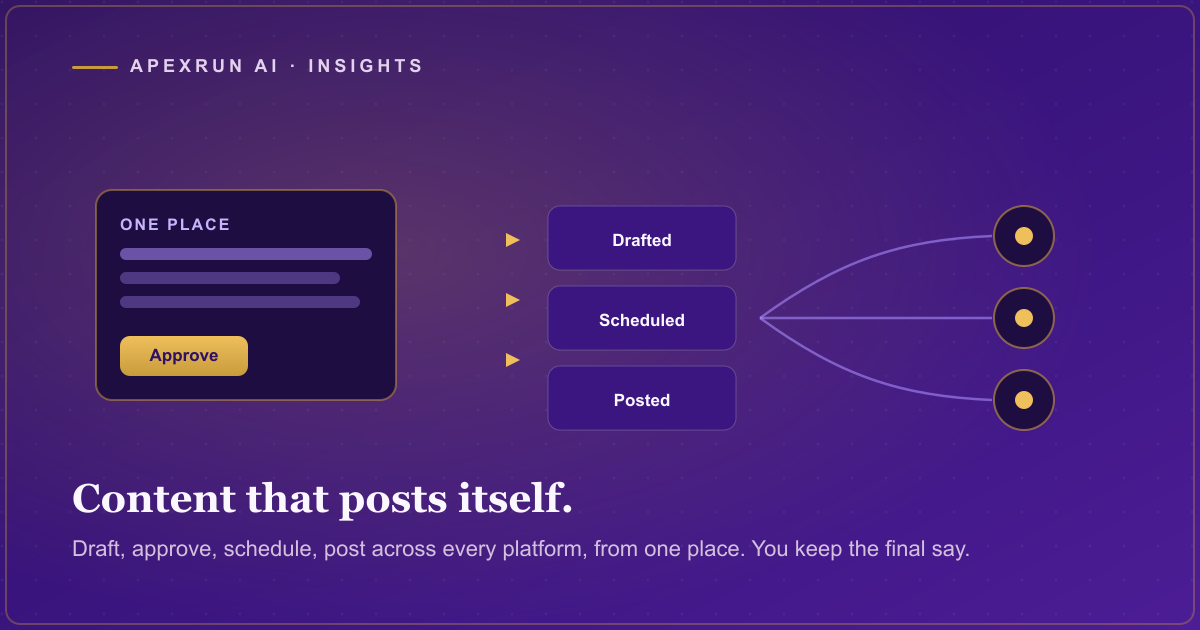
The marketing layer runs the work of staying visible: drafting the content, scheduling the posts, keeping the pipeline warm. It is the part of the business that owners drop first when they get busy, which is exactly why having a system carry it matters.
The intelligence layer is where judgment-adjacent work happens: summarizing, researching, drafting, pulling the numbers, surfacing what needs your attention. It turns raw information into something you can act on in seconds instead of hours.
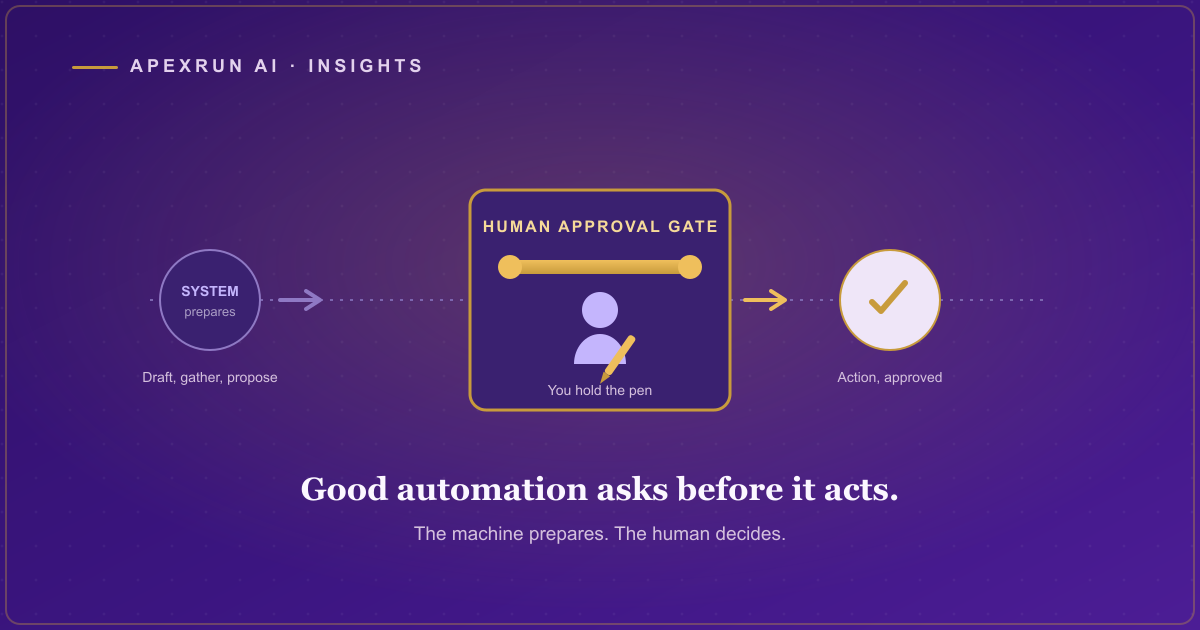
The automation layer sits on top and ties the flows together, so a trigger in one place sets off the right sequence everywhere else, with a human approval gate wherever a mistake would be costly. This is the layer that makes the whole thing run without you pressing the buttons.
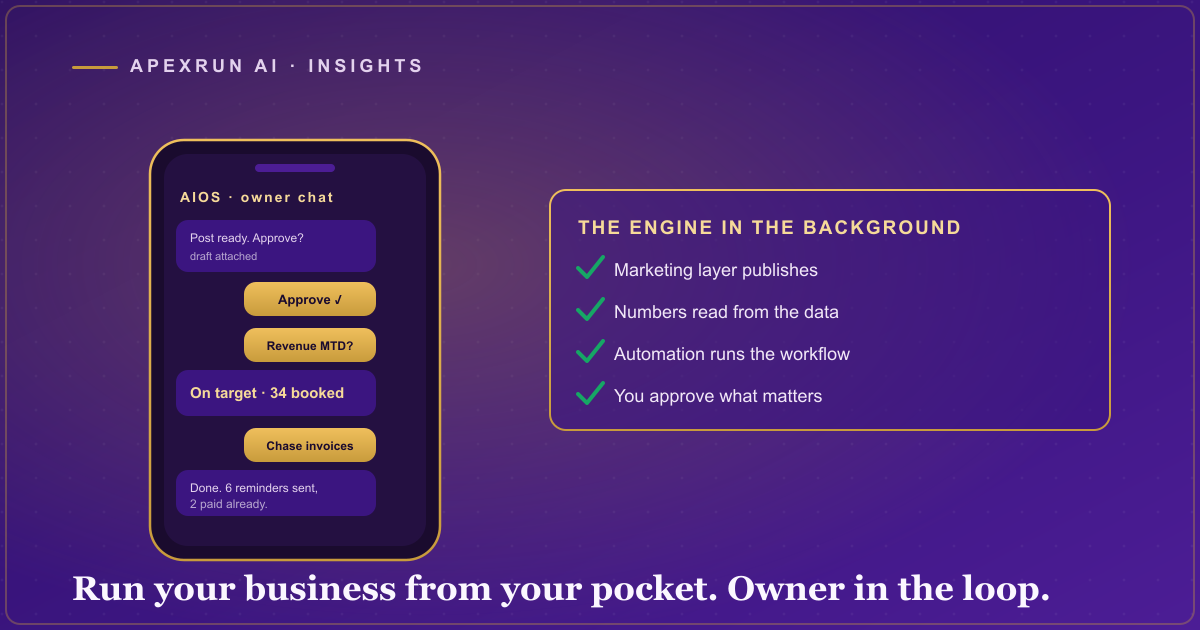
Here is what those five layers look like working as one. A new enquiry comes in through the website. The communication layer captures it and replies straight away. The context layer recognizes whether this is a new prospect or an existing client and pulls the relevant history. The intelligence layer drafts a tailored response and a short internal briefing. The automation layer books the next step, updates the record, and queues a follow-up, holding anything sensitive for your approval. Five layers, one motion, and you did not touch a keyboard until the moment your judgment was actually required. That is what a system does that a stack of separate apps cannot.
Order matters. You cannot bolt automation onto a business with no context and expect anything but chaos, which is precisely the mistake behind a pile of disconnected tools. The layers get built from the bottom up, which is why the sequence you build in decides whether you get a system or a mess.
What this means for you
The practical takeaway is simple. If your current AI setup is a chatbot you visit and a few tools you copy between, you do not have an operating system. You have parts. That is not a criticism; it is where almost everyone starts. But it caps how much time you can actually get back, because you are still the coordinator.
An AI operating system removes you from that role. It runs the recurring load as one connected flow and loops you in only where your judgment is genuinely needed. If you want to see how that maps to a business in your line of work, the industries breakdown walks through it by sector.
The honest way to find out what your business actually needs, which layer to build first and which tools you can drop, is the Free CEO Audit. In one hour we map your operation, identify where a coordinated system would take the most work off your plate, and hand you a prioritized plan, so you build a machine on purpose instead of accumulating parts by accident.