There is a comfortable story owners tell themselves about AI. The story goes: this is moving fast, the tools are half-baked, and the smart move is to wait until it settles, then adopt the mature version and skip the pain. It sounds prudent. It is the single most expensive assumption a business can make right now, because businesses falling behind on AI are not falling behind on a feature. They are falling behind on a compounding rate, and compounding does not wait for you to feel ready.
Here is the part the wait-and-see story gets wrong. It treats AI adoption like buying a phone, where the person who waits two years buys a better phone for less money. But adoption is not a purchase. It is a rate of improvement. And a rate that compounds behaves nothing like a product you can pick up later at a discount.
Why businesses falling behind on AI cannot simply sprint to catch up
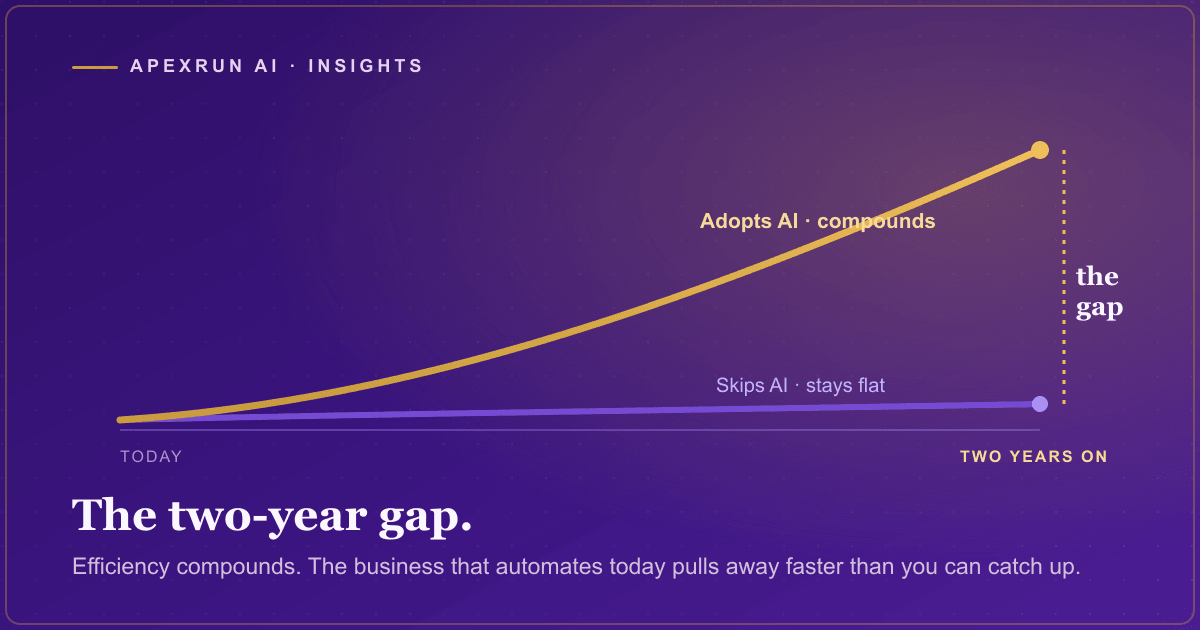
Picture two competitors in the same market, same size, same starting point today. One of them maps their operation and automates the recurring admin: the intake, the follow-ups, the reports, the reconciliation, the first drafts. The other one waits.
By the end of month one, the difference is small. The one who automated saved a few hours. Nothing dramatic. This is exactly why waiting feels safe. The early lead looks trivial.
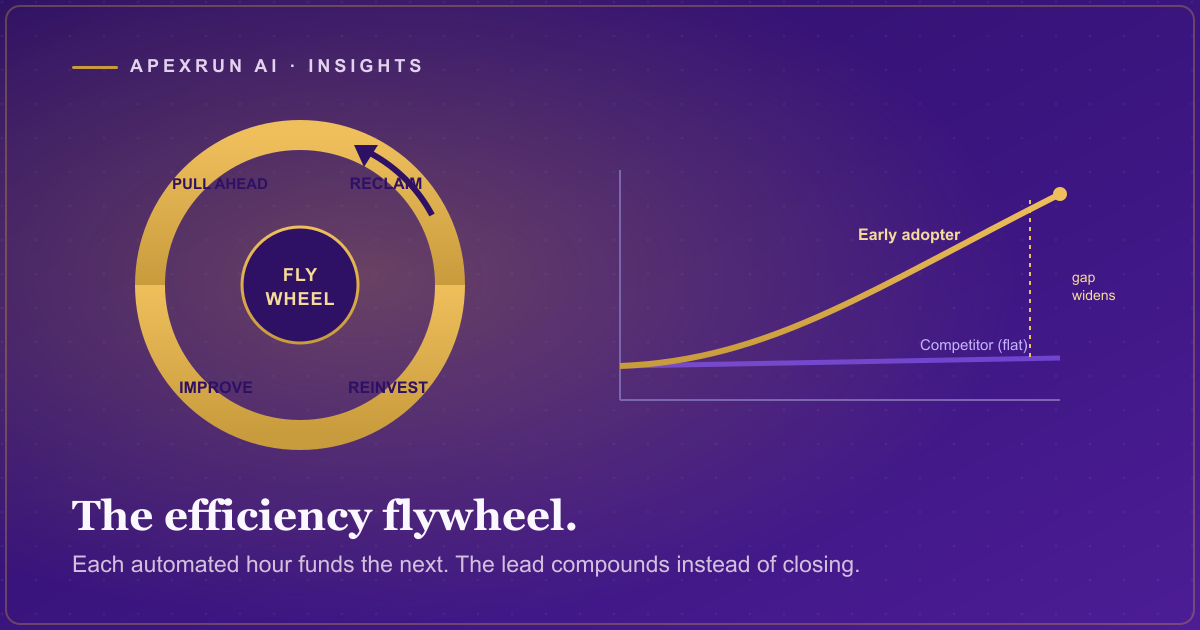
But watch what those reclaimed hours do. They do not vanish. They get spent on the work that actually grows the business: winning clients, improving the offer, serving better, building the next thing. That work produces more revenue, which funds the next automation, which frees more hours, which fund more growth. Each turn of the loop makes the next turn easier. That is what compounding means. The advantage is not the hours saved this week. It is that this week’s saved hours are buying next week’s larger saved hours.
The competitor who waited is not standing still, but they are running the business by hand. Their capacity is capped at whatever their team can physically do. When they finally decide to adopt, two years from now, they do not arrive at the same starting line their rival left. They arrive at the starting line while their rival is most of the way around the track and accelerating. The gap is not two years of tooling. It is two years of compounded margin, speed, and reinvestment that the leader converted into structural advantage.
The gap shows up in three places you actually feel
This is not abstract. A widening efficiency gap becomes a widening business gap in ways your customers and your bank account both notice.
Margin. The business that automates its overhead runs the same revenue at a lower cost to serve. That extra margin is a weapon. They can cut price and still profit, or hold price and outspend you on growth. You cannot match either move by working harder, because your cost base is stuck at manual.
Speed. When intake, quoting, and follow-up happen the moment a lead arrives instead of whenever a human gets to it, the automated business responds in minutes while you respond in a day. In most markets the fast response wins the job. You lose deals you never knew you were in.
Responsiveness at scale. The manual business hits a wall every time it grows, because more customers means more admin means more hiring. The automated business absorbs growth without the wall, because the operating system carries the load. One of them can take on a surge of demand. The other one drops balls and burns out.
This is economics, not doom
I want to be careful here, because the “adopt or die” pitch is usually fear dressed up as strategy. That is not the argument. Plenty of businesses will run for years without touching AI, especially ones with a moat that has nothing to do with efficiency: a location, a relationship, a licence, a brand people trust.
The argument is narrower and harder to dodge. Wherever your business competes on cost, speed, or responsiveness, and most do on at least one, efficiency is the game. And efficiency is now compounding for the people who started. The cost of waiting is not zero and it is not flat. It is the lead your competitor builds every single quarter you deliberate, and that lead gets more expensive to close the longer you leave it.
The good news buried in that math is that the same compounding works for you the moment you start. You do not have to out-run a two-year head start on day one. You have to start the loop, because a loop that is turning beats a loop that has not begun, and you would rather be the business other people are trying to catch.
What starting actually requires
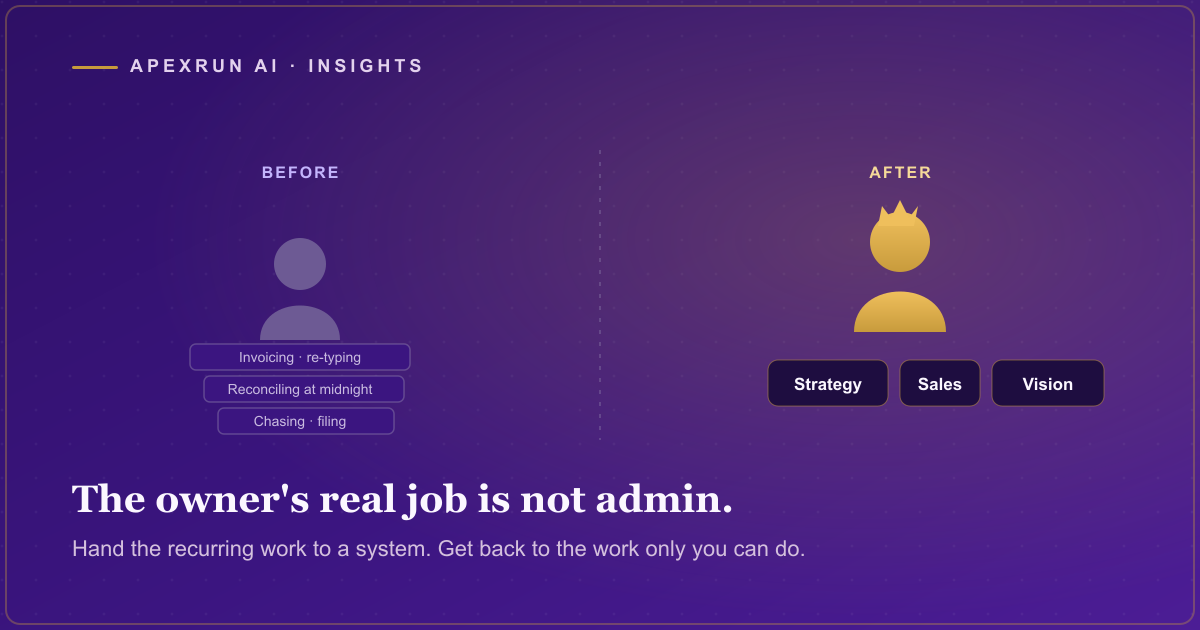
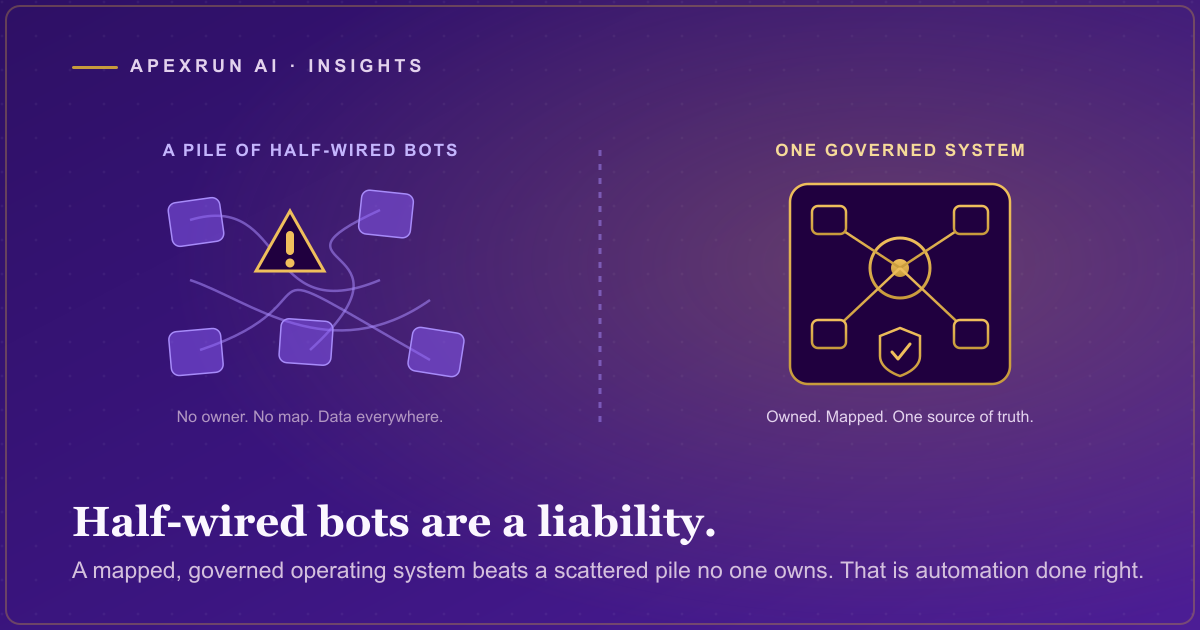
Starting does not mean buying a pile of AI tools and hoping they add up. That is its own trap, and it usually makes things worse rather than better. Starting means understanding your operation as a system, finding the one or two automations that pay back fastest, and building those first, so the hours you free immediately fund the next move.
To make it concrete: one process we automated took a recurring task from about five hours a week of manual work down to roughly one hour a month of review. That is not a headline number, it is one task. But the loop does not stop at one task. The hours it freed went straight into the next improvement, and the one after that, which is precisely how a small early lead turns into a gap nobody can close by working weekends. The competitor still doing that task by hand is spending five hours a week that will never come back, every week, forever, while paying the opportunity cost of whatever those hours could have built.
That is the whole reason an AI operating system beats a drawer of disconnected gadgets. It does not automate one task in isolation. It runs the flow end to end and gives you back the compounding, instead of leaving you to stitch tools together by hand. If you want to see how the pieces fit for a business like yours, the breakdown by sector on our industries page is a practical place to start, and the deeper argument about your own hourly economics is in Stop Doing $20 Work in a $400 Seat.
The businesses that will look untouchable in two years are not smarter than you. They just started the loop earlier and let it run. The only variable you control is when you start yours.
The fastest way to find your highest-return first automation is the Free CEO Audit. In one hour, direct with the decision-maker, we map where your operation leaks time and money, identify the automation that pays back fastest, and hand you a prioritized plan, so you start the compounding on the right move instead of guessing.