Every owner asks the same fair question before spending on automation: what is the return? And most vendors answer it badly, with a vague promise of “efficiency” or a case study from a business nothing like yours. Let me give you the actual framework instead, because the AI automation ROI math is not complicated, and you can run it on your own business in about ten minutes, before you talk to anyone or spend a dollar.
The reason to do this yourself first is simple. If you cannot see the return in your own numbers, you should not buy. And if you can see it, you will stop hesitating, because for most businesses carrying real admin load, the math is not close. The problem was never the ROI. It was that nobody handed you the formula.
The formula
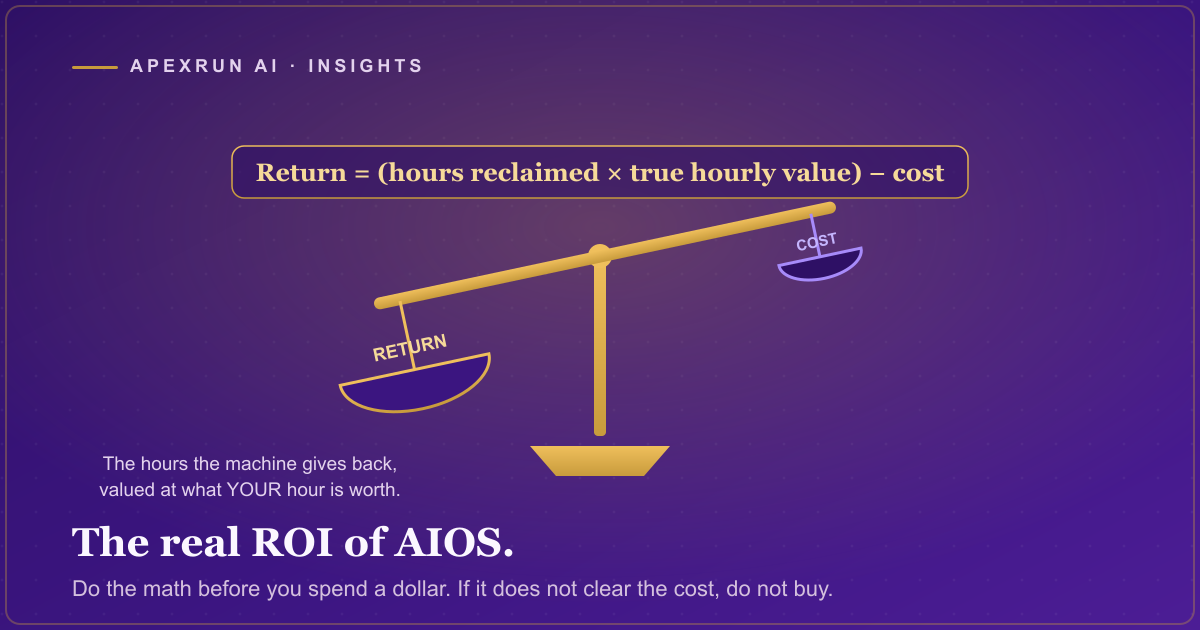
Here it is, whole:
Return = (hours reclaimed x your true hourly value) minus the cost of the system.
Three inputs. Get each one honest and the answer falls out. Most people get the second input wrong, which is why they underestimate the return by a mile.
Input one: hours reclaimed
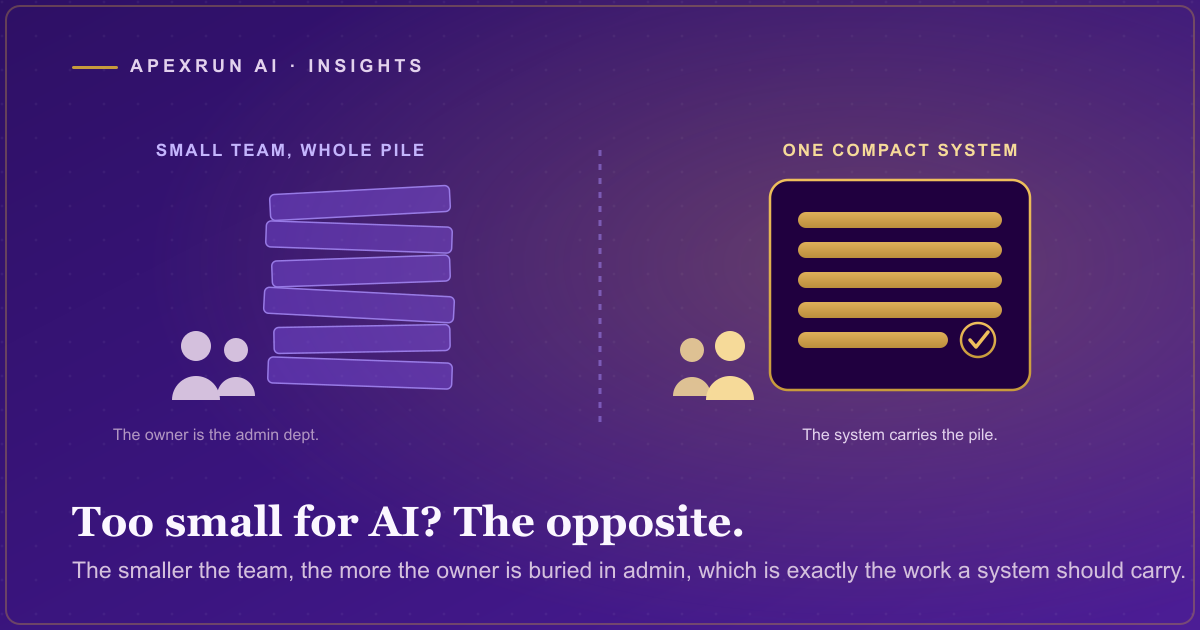
Start with the work a system would actually take off your plate. Not a fantasy number, the real recurring admin: reporting, invoicing, follow-ups, data entry, scheduling, first drafts, the chasing. Write down what you and your team spend on it in a normal week.
Be conservative on purpose. If you think a system could absorb ten hours a week, model seven. You want the ROI to survive a pessimistic estimate, because a return that only works on optimistic inputs is not a return, it is a hope. For most small businesses this number lands somewhere in the many-hours-per-week range once you count everything, and owners are consistently surprised by the total because the admin is scattered and never gets added up. Tallying it is half the value of the exercise on its own.
Input two: your true hourly value (this is the one everyone gets wrong)
Here is where the math usually goes sideways. People plug in what they pay an admin, or worse, minimum wage, because “it is just admin.” Wrong input. The relevant number is not what the task is worth on the open market. It is what your hour is worth, because your hour is what the task is consuming.
If you are an owner whose hour, spent on the right work, generates revenue at a certain rate, then every hour you spend on admin costs you that rate in opportunity, not the clerk’s wage. A professional billing at a high rate who does two hours of admin is not saving the price of an assistant. They are burning their own billable hour to avoid a much smaller cost. Your true hourly value is what you could produce with the hour if it were free, and for most owners that is dramatically higher than the wage they mentally assign to the admin. Use the real number. It is the whole reason the ROI is large.
Input three: the cost
Then subtract what the system costs. This is the one input vendors want you to focus on because it is the only one that favors inaction, but in an honest calculation it is usually the smallest term. And with a locally run AIOS, the ongoing cost profile is different from metered cloud tools, because the highest-volume work runs on hardware you own rather than billing you per request. The economics of that are their own topic, but for the ROI math the point is that the cost term does not scale up every time you use the system more.
Run the numbers
Put it together with placeholder figures so you can see the shape [ESTIMATED, illustrative only, use your own numbers].
Say a system reclaims 7 hours a week. Say your true hourly value is meaningful, the amount you would actually generate with a free hour. That is 7 hours times your rate, every week, of recovered capacity. Multiply by roughly 50 working weeks and you have the annual gross return. Now subtract the annual cost of the system. For most businesses with real admin load, the return dwarfs the cost so decisively that the exact inputs barely matter, the sign of the answer is never in doubt.
That is the honest reason the free audit exists. Not to compute a number you could not compute yourself, but to get the inputs right, because owners systematically underestimate their reclaimed hours and undervalue their own time, which makes them undersell their own return.
Why this beats the way you are probably comparing tools
Most people evaluate AI by feature list. This tool does X, that one does Y, this chatbot is clever. That is the wrong axis entirely. A clever chatbot that saves you nothing recurring has a terrible ROI. A less flashy system that quietly removes ten hours of admin a week has a spectacular one. The question is never how impressive the AI is. It is how many of your valuable hours it gives back, reliably, every week. This is the same reason a chatbot is not a system: the ROI lives in the recurring work an operating system runs in the background, not in a slick answer to a prompt.
It is also why the return compounds rather than sitting flat. The hours a system reclaims get reinvested into the work that grows the business, which is why the real-world ROI usually beats the first-year calculation. The formula above is the floor, not the ceiling. You can see how the connected pieces that produce those recurring savings fit together on our packages page, and the same math runs across every industry, only the inputs change.
The one number that decides it
Strip away everything else and the decision comes down to a single comparison: your true hourly value against the wage of the work you are doing by hand. The moment your hour is worth more than the task consuming it, doing that task yourself is a loss you take every week. Automation is not an expense in that situation. It is the correction of a standing error.
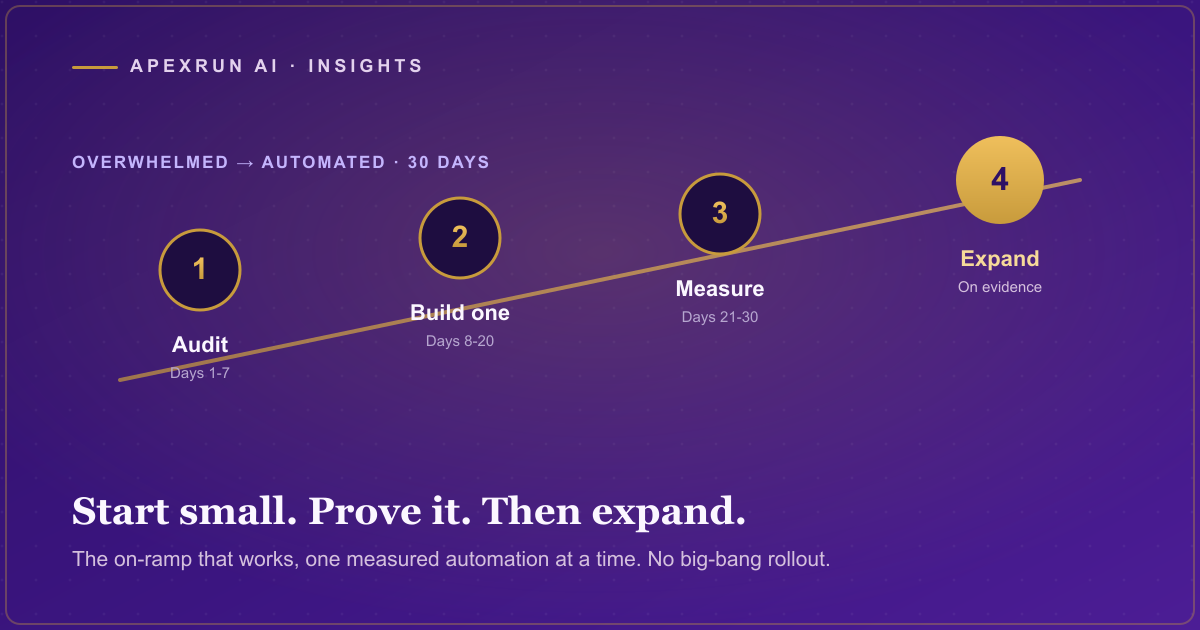
Run the formula on your own business. If it does not clear the cost by a wide margin, do not buy. If it does, the only question left is what to automate first.
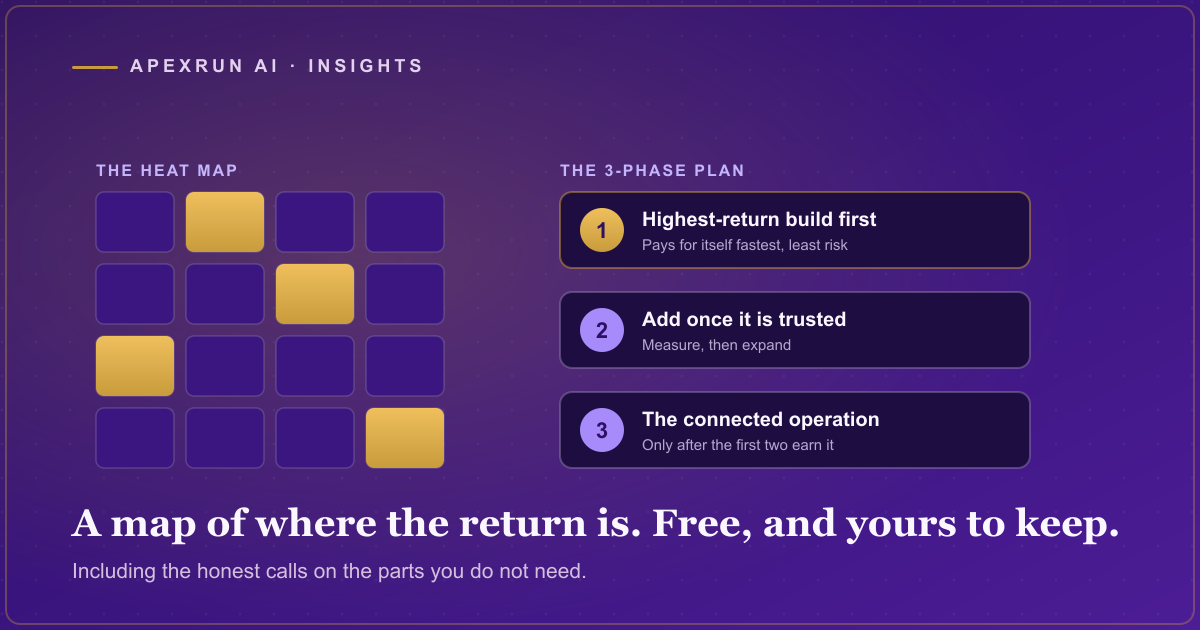
Getting the inputs right, and answering that last question, is exactly what the Free CEO Audit does. In one hour, direct with the decision-maker, we tally your real reclaimable hours, pin down your true hourly value, and hand you the ROI for your specific business alongside a prioritized plan, so you know the number and the first move before you spend a dollar.