There is a question every business handling sensitive information should ask before it types a single client detail into an AI tool: where does this data actually go, and who can touch it once it leaves my building? For most cloud AI services the honest answer is uncomfortable. It goes to a data centre you do not control, in a country whose laws you do not answer to, through a pipe you cannot inspect. For legal, financial, and health work, private AI on premise for your business is not a nice-to-have. It is the design that removes the exposure the cloud creates.
I am not making a fear argument. I am making a threat-model argument, which is a different and more useful thing. A threat model asks a plain question: what are all the points where this could leak, and which of them does a given design remove? Run that on cloud AI versus local AI and the difference is not a matter of degree. Local removes entire categories of risk rather than mitigating them.
The threat model of cloud AI for sensitive work
When you send data to a cloud AI service, you create several distinct exposure points. Name them, because vendors prefer you do not.
The data leaves your control. The moment a client’s medical history, a privileged legal document, or a financial file goes to an external API, custody has changed. It now sits on infrastructure you do not own, governed by a contract you did not write, subject to that provider’s practices for how it is stored, logged, and retained. You are trusting a third party’s word, and trust is not a control.
It may be used to train models. Depending on the service and the tier, what you send can be retained and used to improve the provider’s systems. Your confidential input becomes a data point in someone else’s model. For privileged or regulated information, that possibility alone is disqualifying, and the terms that govern it can change under you.
It crosses a border. Most major cloud AI runs through US data centres. Once your data lands there it is subject to that jurisdiction, including legal processes you have no visibility into and no standing to contest. For a Canadian firm with obligations to keep client data in Canada, this is a hard problem, not a soft preference, and I laid out the residency side of it in full in why your data should not live in a US data centre.
Every request widens the surface. Each call to a cloud service is another transit of sensitive data across the public internet to an external party. More usage means more exposure, which creates the perverse situation where the more useful the tool becomes to you, the more of your sensitive data you have shipped offshore.
None of these are edge cases or bad luck. They are the normal, designed behavior of sending data to someone else’s cloud. That is the point. The risk is structural, not accidental, which means you cannot policy your way out of it. You can only design your way out.
How local deployment removes the leak surface
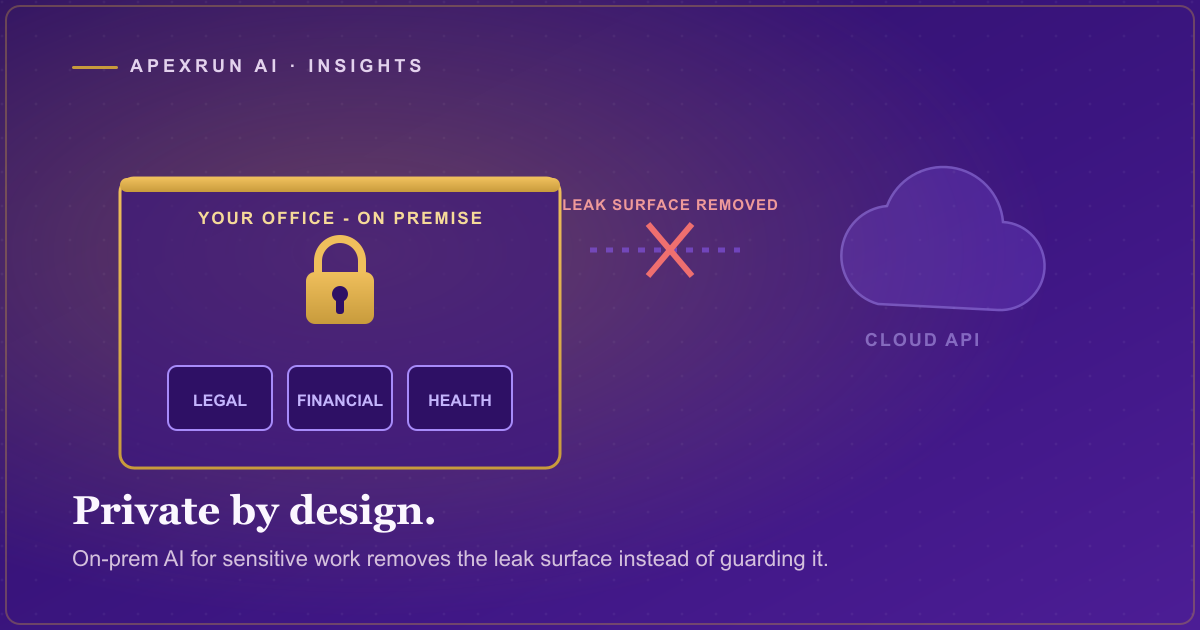
Here is the shift. An AI operating system does not have to run in the cloud. It can run on a machine in your own office, on a local model, and when it does, the entire threat model above collapses.
The data never leaves your building, so custody never changes. There is no external party to trust with it because there is no external party. It cannot be used to train someone else’s model because it never reaches anyone else’s model. It does not cross a border because it does not go anywhere. And usage does not widen the surface, because the highest-volume, most sensitive work runs on hardware you own, inside your own walls.
This is what “private by design” means, and the phrase is precise. You are not adding privacy controls on top of a leaky architecture and hoping they hold. You are choosing an architecture where the leak points do not exist in the first place. A control you bolt on can fail or be misconfigured. A risk that is structurally absent cannot. That is a categorically stronger position, and it is the reason regulated firms should treat local deployment as the default rather than the upgrade.
Who this is non-negotiable for
Some businesses can reasonably use cloud AI. A marketing team drafting social posts is not handling anything that would end a client relationship if it leaked. But three kinds of work sit on the other side of a bright line.
Legal. Privilege is the foundation of the work, and privilege does not survive careless handling. Client files, case strategy, and privileged communications cannot be shipped to an external API without putting the thing that makes the practice a practice at risk. This is exactly why we run local models for legal work, and you can see how it maps to a firm on our legal command book.
Financial. Advisors and accountants hold clients’ entire financial lives, under regulators who take data handling seriously. A leak here is not embarrassing, it is a compliance event with consequences.
Health. Patient information is protected by law and by an ethical duty older than any statute. Sending it to a cloud service in another country is precisely what those protections exist to prevent.
For all three, the efficiency of AI was never the barrier. The barrier was that the standard way of getting it required handing sensitive data to a third party across a border. Local deployment removes the barrier by removing the requirement.
The trade-off, stated honestly
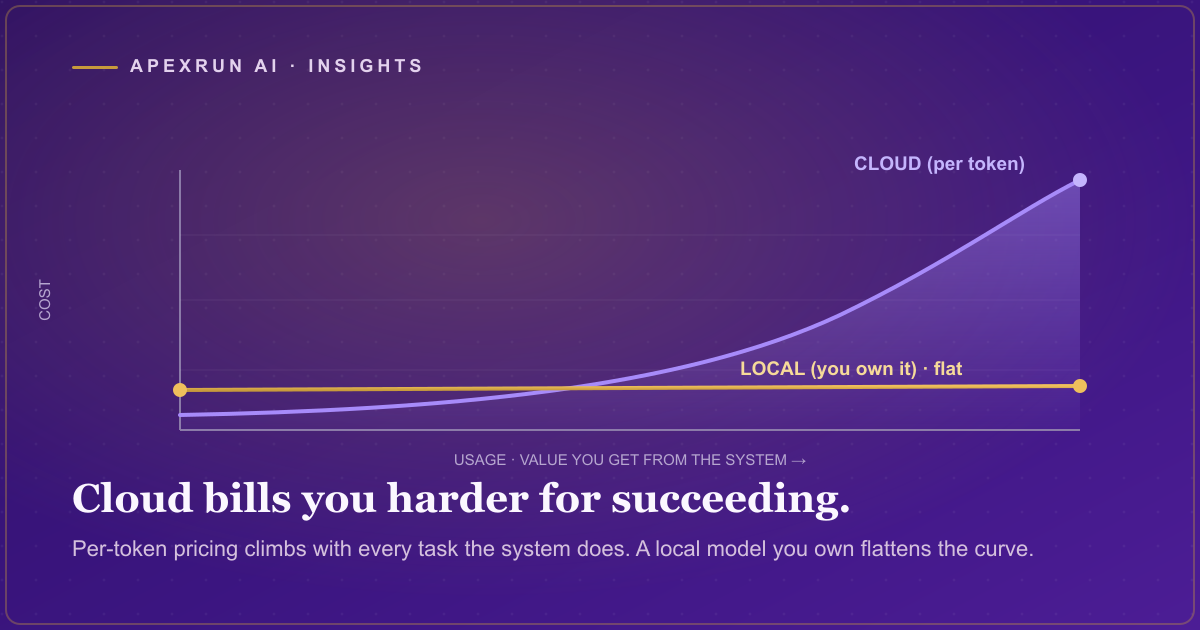
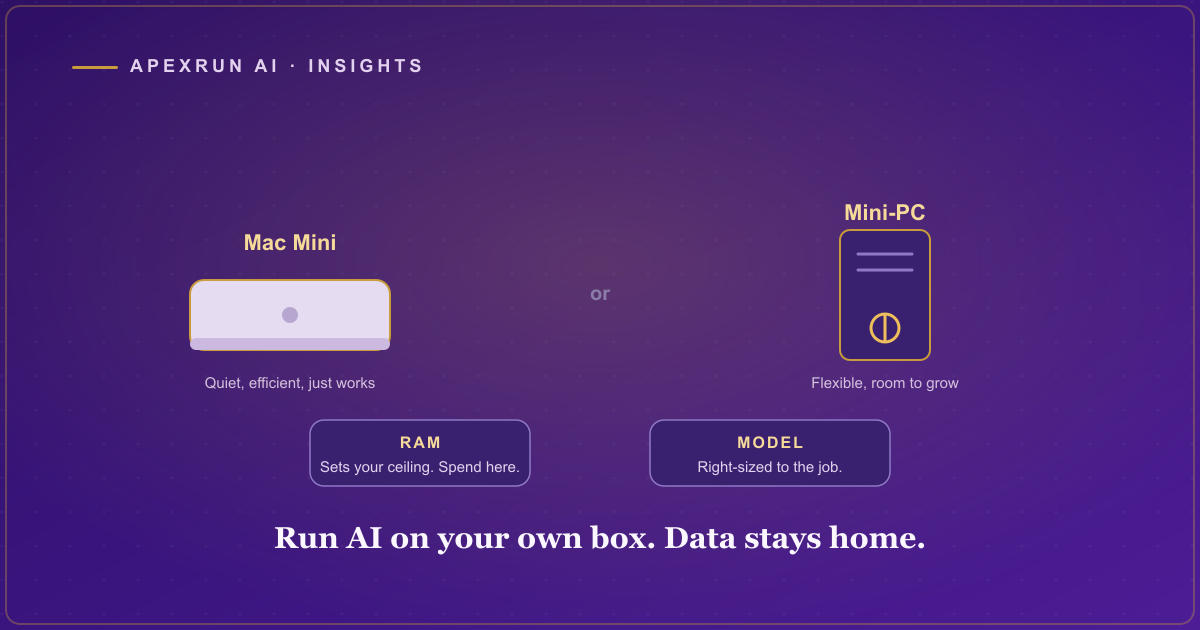
Running AI locally is not free of effort. It needs hardware, and it needs to be set up properly rather than signed up for with a credit card in five minutes. That is the real trade. What you get for it is complete custody of your data and a cost profile that does not bill you per request on your highest-volume work, since it runs on a box you already own.
For a business whose sensitive data is the core of the client relationship, that trade is not close. A slightly heavier setup once, in exchange for the leak surface being gone permanently, is the right deal every time. If you are still mapping what an operating system is before weighing where it should run, what an AIOS is sets up the frame, and location becomes a decision you make on top of it.
Where to start
Do not start by picking a cloud tool and then worrying about privacy after your data is already in it. Start from the sensitivity of your data and let that decide the architecture. For legal, financial, and health work, that decision points to local, and it points there before you automate anything.
That decision is part of what the Free CEO Audit works through. In one hour, direct with the decision-maker, we map what an AIOS can automate in your business and where it should run given the sensitivity of your data, and hand you a prioritized plan, so you get the automation without ever putting your clients’ information somewhere it should not be.