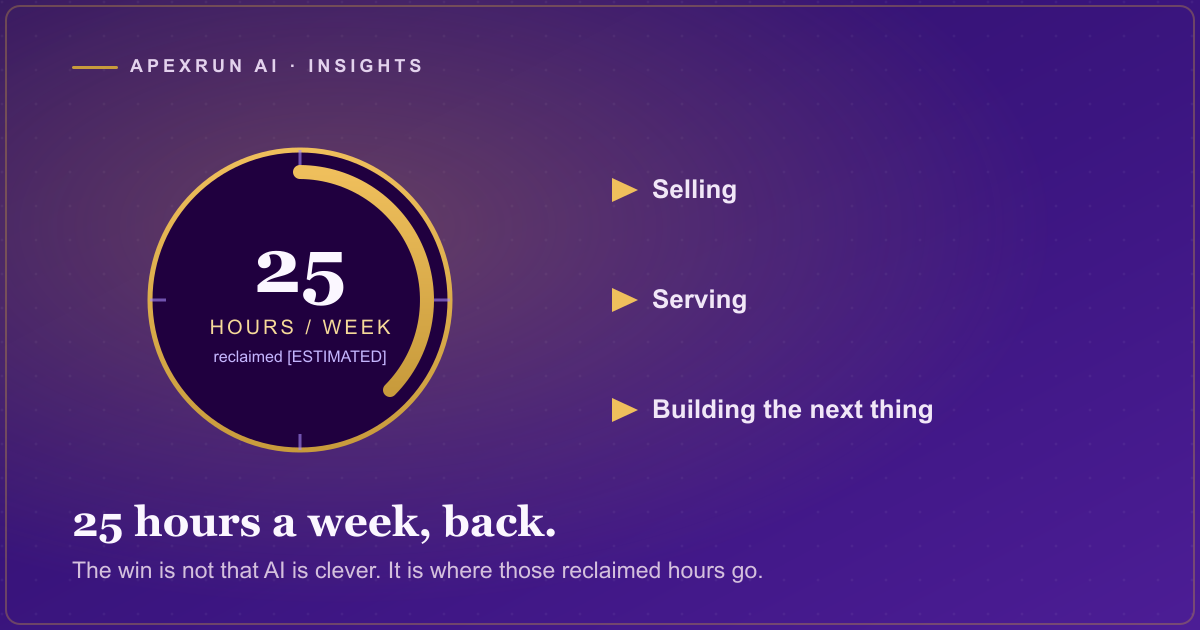
I want to tell you about an owner who got roughly 25 hours a week back, but the number is the least interesting part of the story, and if I stop there I have told you nothing useful. Every AI pitch waves a big hours-saved figure at you. What almost none of them tell you is the part that actually matters: what a small business owner does to reclaim time in the first place, and then what happens to those hours once they exist. The hours are not the win. Where they go is the win. An owner who reclaims 25 hours and pours them straight back into more admin has gained nothing but a bigger pile.
So let me tell it properly. This is a composite, drawn from the pattern I see again and again rather than one named client, and every figure in it is [ESTIMATED] and illustrative. The shape is real even where the specific numbers are stand-ins.
Before: the owner was the operation
Picture the owner of a small services business. Fifteen people, healthy demand, the kind of company that looks successful from the outside and feels like a treadmill from the inside. The owner started their week at maybe 60 hours [ESTIMATED], and if you followed them around, most of it was not the work they were good at. It was the work that had nowhere else to go.
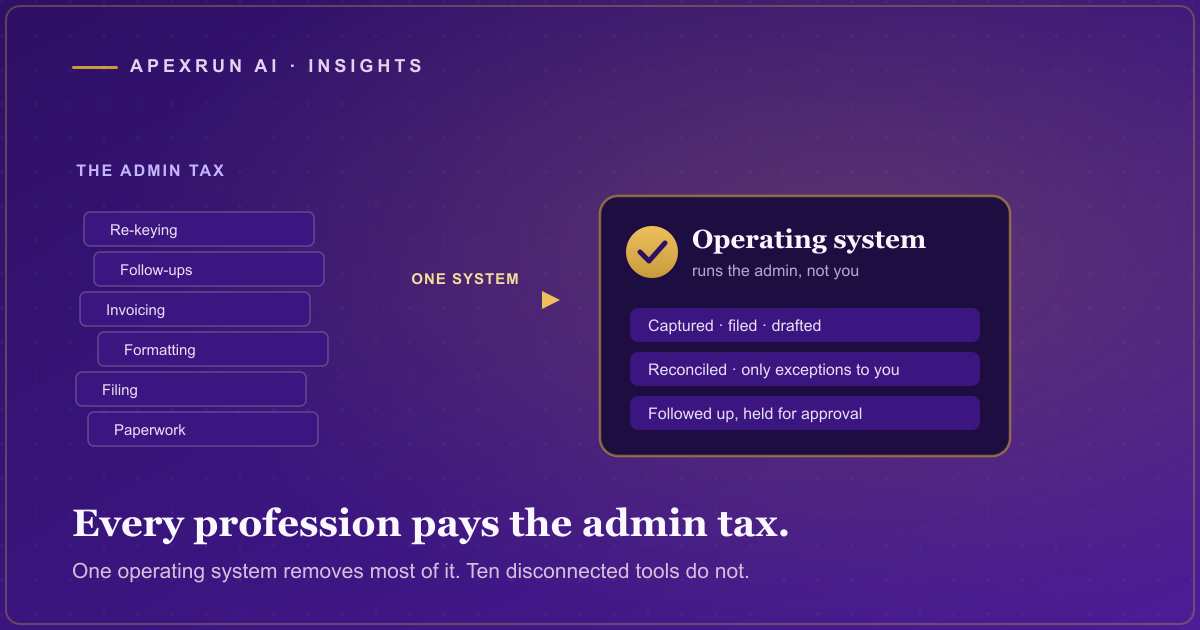
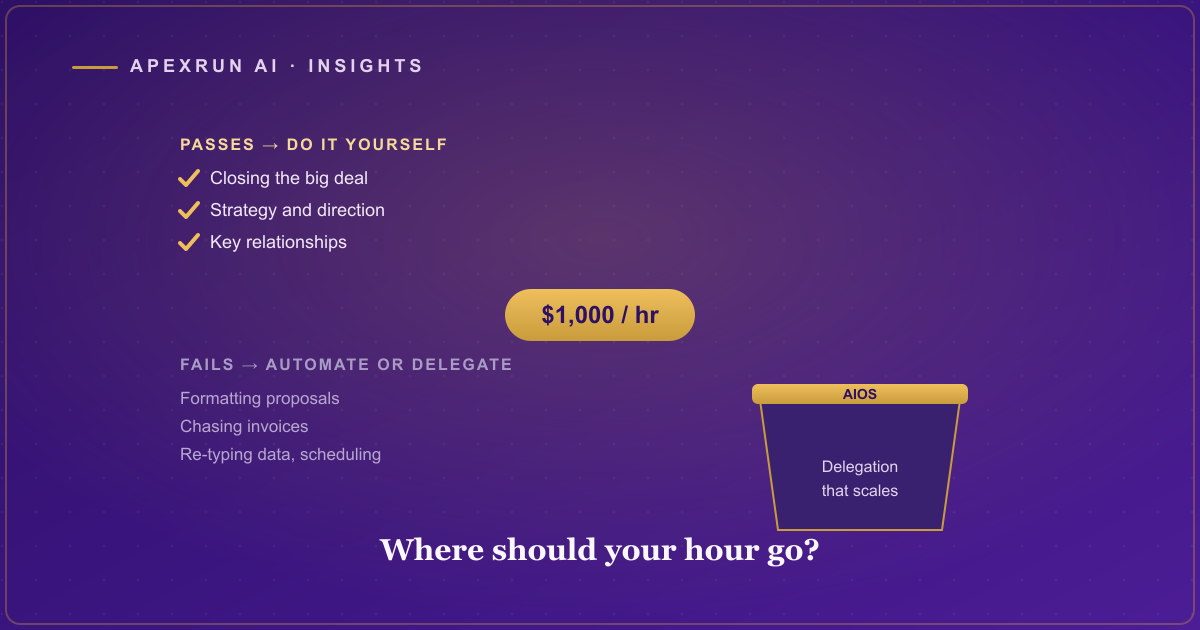
Mornings gone to their inbox, answering the same questions they answered last week. Quotes built by hand at night because the day was full. Follow-ups that happened when there was a spare minute, which meant often they did not happen. The weekly report assembled by hand. Invoices raised late because raising them was one more thing. Scheduling, intake, chasing, re-keying. Call it 25 to 30 hours a week [ESTIMATED] of work that needed to get done but did not need to be done by the owner. They were, in the phrase I keep coming back to, the most expensive clerk in their own building. I made that full argument in Stop Doing $20 Work in a $400 Seat, because it is the trap underneath this whole story.
The owner did not have a demand problem or a talent problem. They had a where-does-my-time-go problem, and the answer was: into the machine that keeps the business running, one manual task at a time.
The change was not dramatic
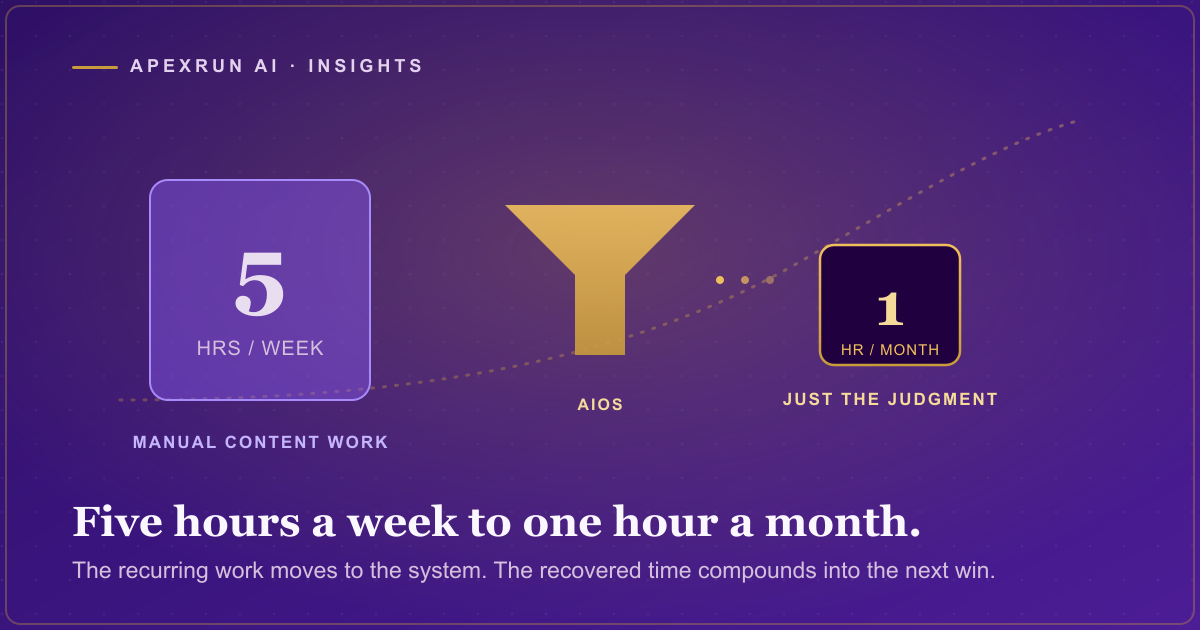
Here is the unglamorous truth about how the 25 hours came back. There was no single magic tool. We mapped the operation, found the recurring admin eating the most time, and built an AI operating system to run it. The intake started capturing itself. The follow-ups drafted and queued on their own. The quotes generated from the inputs instead of from a blank page at 9pm. The report wrote its own first draft. The invoices raised themselves the moment work closed. None of it replaced the owner’s judgment. Every piece that mattered still passed across their desk for approval. The system just stopped making them the one who assembled everything from scratch.
Task by task, the 25-ish hours of clerical load [ESTIMATED] dropped to a few hours of review. That is the whole mechanism. Not cleverness. Subtraction. The boring work stopped landing on the owner.
What they actually did with the hours
This is the part that matters, and it is the part the case studies skip. Twenty-five reclaimed hours is not a result. It is a resource, and a resource does nothing until you deploy it. Here is where this owner put theirs, and it maps to the only three places reclaimed time is worth anything.
Selling. Some of the hours went to the top of the business: talking to prospects, following up on the deals that were actually close, showing up where revenue is decided. The owner had been too buried in admin to sell, which is a quietly insane way to run a company, since selling is the one job nobody else can do for them. The hours moved there first, and the pipeline responded.
Serving. Some went to existing clients. Actual attention, better delivery, the calls that turn a satisfied client into a loyal one who refers. The business had been running clients through a machine that worked but never had time to be good. Now it had time to be good, and retention is cheaper than acquisition every day of the week. This is the return that never shows up in a case study because it is slow and quiet: the client who stays an extra two years, the referral that arrives because someone felt looked after. Those are worth more than any single deal, and they only happen when the owner has the hours to be present instead of buried.
Building. And some went to the thing owners never get to: working on the business instead of in it. The new offer. The next hire. The system that would let them grow past their current ceiling. This is the work that had been on the “someday” list for years because someday never had any hours in it. Suddenly it did.
The reframe that makes this worth doing
If you take one thing from this, take this. The value of AI for an owner is not that it does impressive things. It is that it converts your worst-spent hours into your best-spent ones. Twenty-five hours of admin is worth very little, because anyone or anything can do it. Twenty-five hours of the owner selling, serving, and building is worth an enormous amount, because only the owner can do it and it compounds. The system did not just save time. It upgraded the time, moving it from the cheapest use to the most valuable one.
That is why “AI is cool” is the wrong reason to do this and “I got my highest-value hours back” is the right one. The owner in this story did not end up impressed by technology. They ended up running a business that had room for them to actually lead it. If you want to see what this looks like in your specific line of work, the sector breakdowns on our industries page show where the reclaimable hours tend to hide.
The fastest way to find your own 25 hours is the Free CEO Audit. In one hour, direct with the decision-maker, we map where your time actually goes, identify the admin an operating system can take off your plate, and hand you a prioritized plan, so you know exactly which hours you are about to get back and what they could be worth once you redeploy them.