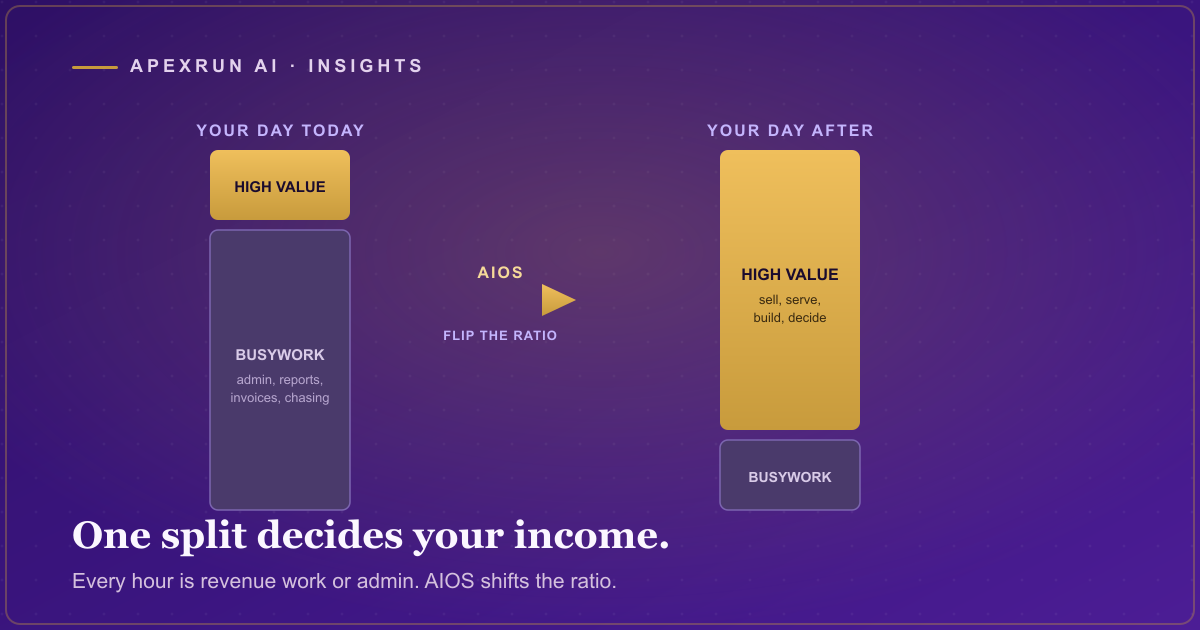
There is one split that quietly decides how much you earn, and most owners never draw it on purpose. Every hour you work falls into one of two buckets. It either moves revenue, or it does not. High value work vs busywork is not a productivity slogan, it is the actual mechanism behind your income, because your earnings are a function of how many of your hours land in the first bucket and how few get eaten by the second. Shift the ratio, and your income moves. Leave it alone, and it stays exactly where it is, no matter how hard you work.
The uncomfortable part is that most people who feel busy, stretched, and maxed out are not short on hours. They are short on high-value hours, because the low-value ones have quietly taken over the day.
The two buckets, drawn plainly
High-value hours are the ones that generate or protect revenue. Selling. Serving clients. Making the judgment call that carries real consequences. Building the relationship that turns into the next deal. Doing the actual craft people pay you for. These hours have a high dollar-per-hour, and they are the entire reason your business earns what it earns.
Low-value hours are everything around that. Reports. Invoices. Data entry. Scheduling. Formatting. Reconciliation. Chasing information. Re-typing things from one system into another. This work has to happen, but it has a low dollar-per-hour, and critically, none of it requires you specifically. A capable system or a junior could do it. When you do it, you are paying your top rate for bottom-rate output.
Draw the line down your own week and the picture is usually stark. People assume their day is mostly high-value with some admin around the edges. When they actually tag each task, it is the reverse: a thin slice of revenue work buried under a mountain of busywork. That inversion is the whole problem, and it is invisible until you measure it. Running that exercise properly is worth an afternoon, and I laid out how in the time-value audit every owner should run.
Why the ratio, not the hours, decides your income
Here is the mechanism, and it is worth sitting with because it changes how you think about work.
Your income is roughly your high-value hours multiplied by their value. That is it. Adding total hours does almost nothing if the added hours are low-value, which is why working weekends rarely moves the number, it just adds more admin to an already admin-heavy week. The only two levers that actually work are raising the value of your high-value hours, and increasing how many of them you get. And the fastest way to get more high-value hours is not to find more time in the day, it is to stop spending the time you already have on the low-value bucket.
This is why two people with identical skill and identical hours can earn wildly different amounts. The higher earner is not working more. They have a better ratio. More of their day lands in the bucket that pays, because they have systematically removed themselves from the bucket that does not.
The trap: low-value work feels productive
The reason the ratio drifts the wrong way is that busywork is genuinely satisfying to do. It is concrete, it has a clear finish, and clearing it gives you the feeling of a productive day. You answered the emails, you did the invoicing, you formatted the report, inbox to zero. It feels like progress.
But feeling productive and generating revenue are not the same thing, and busywork is where they diverge hardest. You can have a full, exhausting, satisfying day and move the income needle by nothing, because every hour of it landed in the wrong bucket. The satisfaction is real. The financial result is zero. That gap is exactly why owners stay stuck: the low-value work rewards them emotionally for doing the thing that keeps them poor.
What an operating system actually does to the ratio
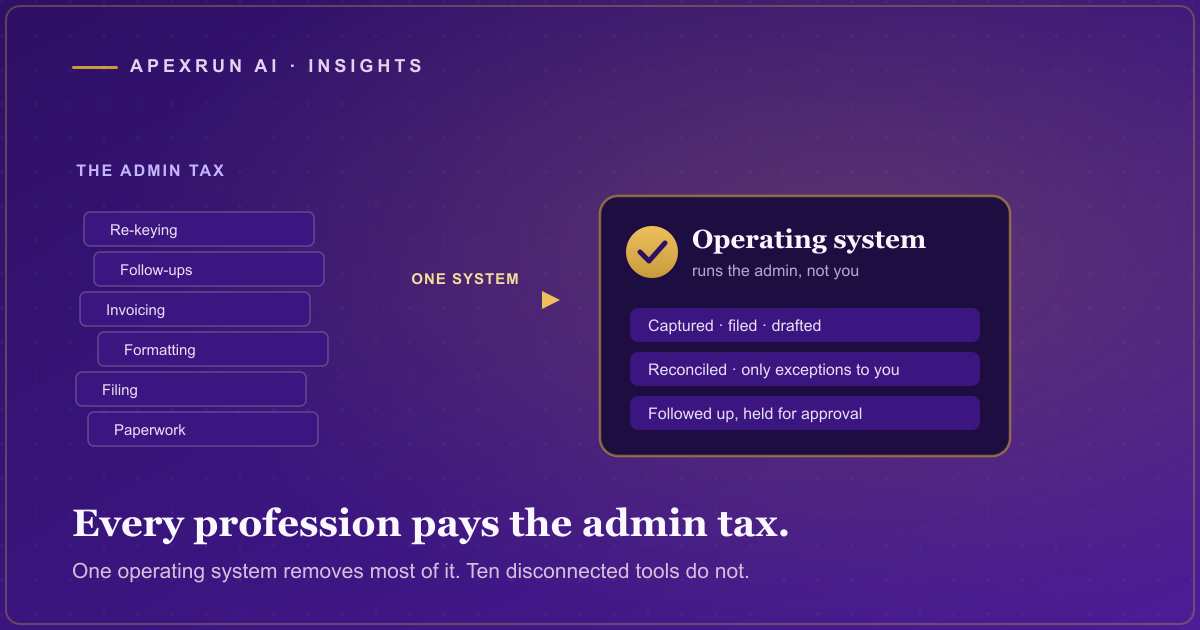
This is where an AI operating system earns its place, and it is a sharper tool for this specific job than most people expect. Its entire function is to take the low-value bucket off your plate so your hours redistribute toward the high-value one.
It drafts the report from your data and waits for your sign-off. It generates and sends the invoice from the logged work. It runs the follow-up cadence in your voice. It handles intake and scheduling. It reconciles the numbers and surfaces only the exceptions. Everywhere a mistake would matter, a human approval gate stays in place, so you are reviewing work instead of producing it. The busywork still gets done. You just stop being the one doing it.
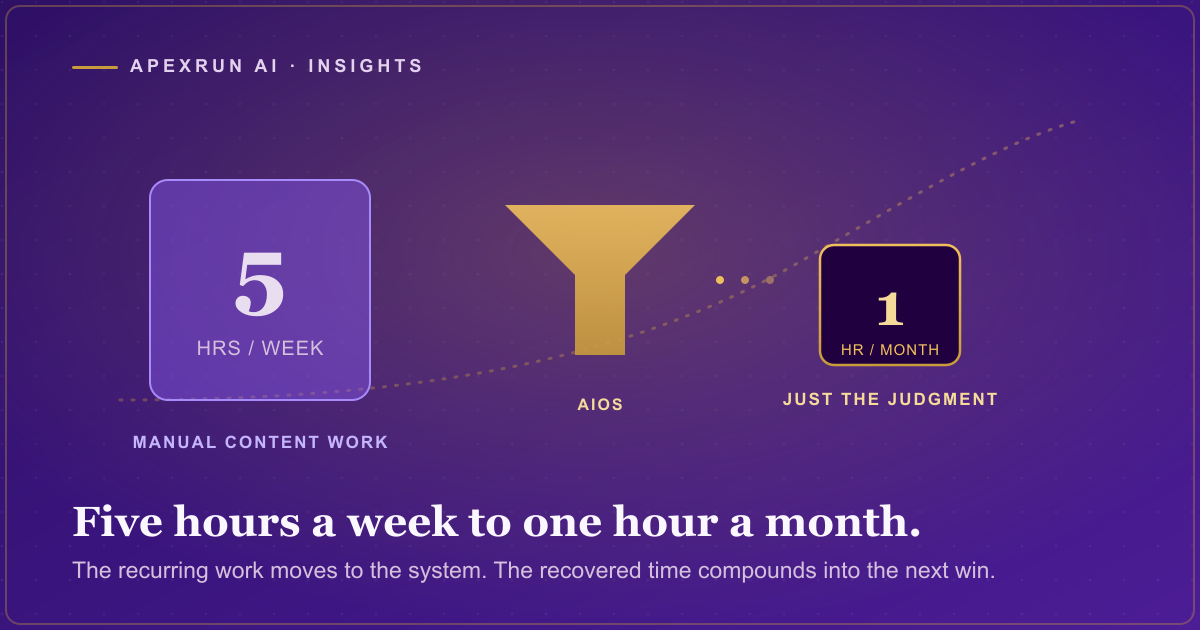
The effect is not “AI is impressive.” The effect is a changed ratio. The hours the system absorbs do not vanish, they move to the bucket that pays. If it takes eight low-value hours a week off you and you put even half of them into selling and serving, your income moves, because you did the one thing that actually moves it: you increased your share of high-value hours. This is the same argument I made in stop doing $20 work in a $400 seat, viewed through the lens of the split that decides your paycheque.
Notice what this is not. It is not a drawer of disconnected apps that each solve one task and hand you two new coordination jobs. An operating system runs the whole low-value flow as one connected sequence, which is the difference between actually clearing the bucket and just moving it around. You can see how the connected pieces fit on the packages page.
Do the split this week
You do not need a consultant to start. Take one week and tag every task you do with a rough dollar-per-hour. Not what you wish it was worth, what a market would pay for that specific task. Then total the low-value bucket. That number, the hours times its low rate, is what your current ratio is costing you. It is almost always bigger than owners guess, and once you have seen it you cannot unsee it.
Then the move is simple: automate the largest, most recurring items in the low-value bucket first, and reclaim those hours for the bucket that pays. Not all at once, in the order that frees the most high-value time per dollar spent.
That prioritization is exactly what the Free CEO Audit produces. In one hour, direct with the decision-maker, we map your two buckets, identify the low-value work an AI operating system can take off you, and hand you a ranked plan, so you know the single highest-return thing to automate first before you spend a dollar. The split decides your income. The audit shows you where yours is leaking, and how to flip it.