Most people underestimate what automation is worth, and they do it because they think about it wrong. They picture a single task getting a bit faster and conclude the payoff is modest. But you reduce admin time with AI far more than that mental model predicts, because the savings do not sit still. They compound. A few hours clawed back this week is not a one-time gift. It is capacity that keeps returning, week after week, and stacks into something that changes what the business can do.
I want to make this concrete with a real example from my own operation, because grounded beats hypothetical every time. This is first-party, not a stat I found somewhere and dressed up. It is what actually happened when I put my own content work onto a system.
A grounded example of how to reduce admin time with AI
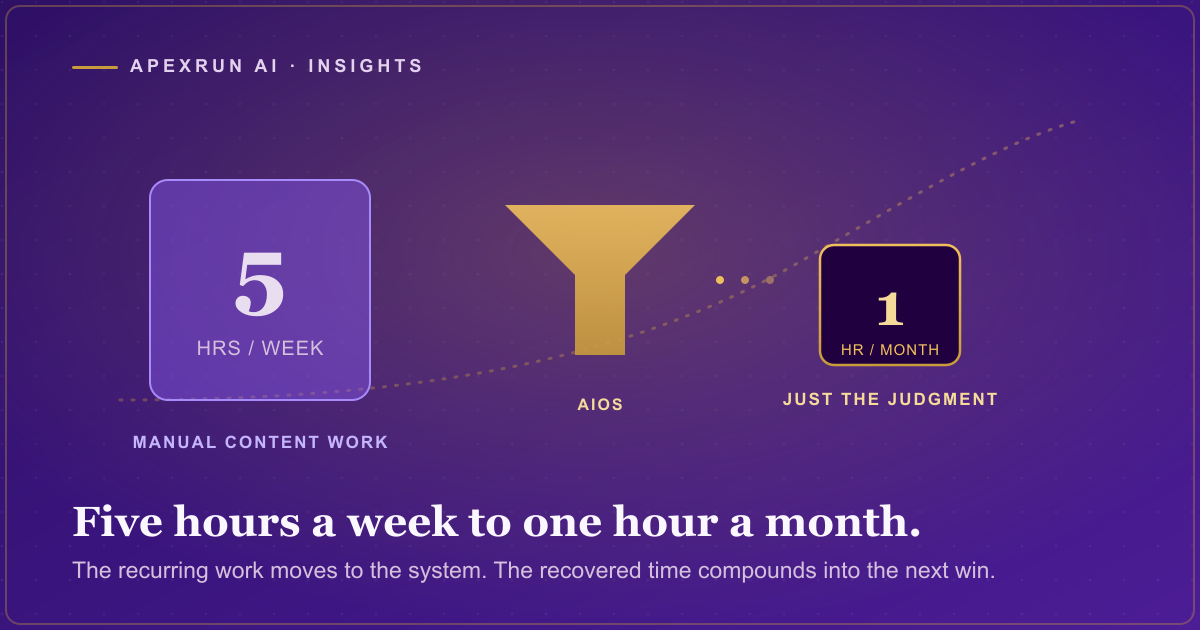
Producing content used to take me about five hours a week. Writing the drafts, formatting them, sizing images, scheduling posts, keeping track of what went out where. None of it was hard. All of it was time, and it was recurring time, the kind that shows up every single week whether or not you feel like doing it. Five hours a week does not sound like much until you multiply it out: it is more than a full working month of every year spent on one category of admin.
Once that work sat on a proper system, the shape of it changed completely. The recurring production, the formatting, the sizing, the scheduling, the tracking, moved off my desk. What is left for me is the judgment: deciding the direction, approving what goes out, making the calls that actually need a person. That remaining slice takes roughly an hour a month. Not an hour a week. An hour a month.
That is the move from five hours a week to about one hour a month, and I want to be honest about what it is and is not. It is not magic, and it is not zero. There is still a human in the loop making the decisions that matter, which is exactly how it should be. What went away was the volume, the repetitive production work that never needed me specifically, and that is where almost all the hours were hiding.
Why the small wins compound
Here is the part people miss. That reclaimed time does not just disappear as “free time.” It becomes fuel for the next thing.
The five hours a week I got back did not sit idle. Some of it went into work that only I can do, the client conversations and the thinking that actually move the business. Some of it went into setting up the next process to take off my plate, which then returned more hours, which funded the next one after that. That is the compounding. One automated process frees the time to build the second. The second frees time to build the third. Each win is small on its own, and the stack of them is what quietly separates a business that scales from one that stays capped at whatever its owner can personally touch.
This is the efficiency flywheel in practice: the first saved hours are the hardest to earn, and every one after that gets easier because you are reinvesting reclaimed capacity instead of spending fresh effort. The businesses that pull ahead are not the ones that found one clever automation. They are the ones that kept feeding the flywheel until the compounding took over.
The number that actually matters is not the percentage
When people evaluate automation, they ask what percentage of a task it removes, and that is the wrong frame. The right frame is what the recovered time compounds into over a year and beyond.
Five hours a week is roughly two hundred and fifty hours a year [ESTIMATED from 50 working weeks]. If that time gets reinvested into higher-value work and into building the next time-saving process, the return is not the two hundred and fifty hours. It is everything those hours produce, plus everything the next reclaimed block produces, and so on. The percentage saved on any single task is almost beside the point. The compounding of the recovered capacity is the whole game, and it is why a modest-looking saving on a recurring task is worth far more than a big saving on a one-off.
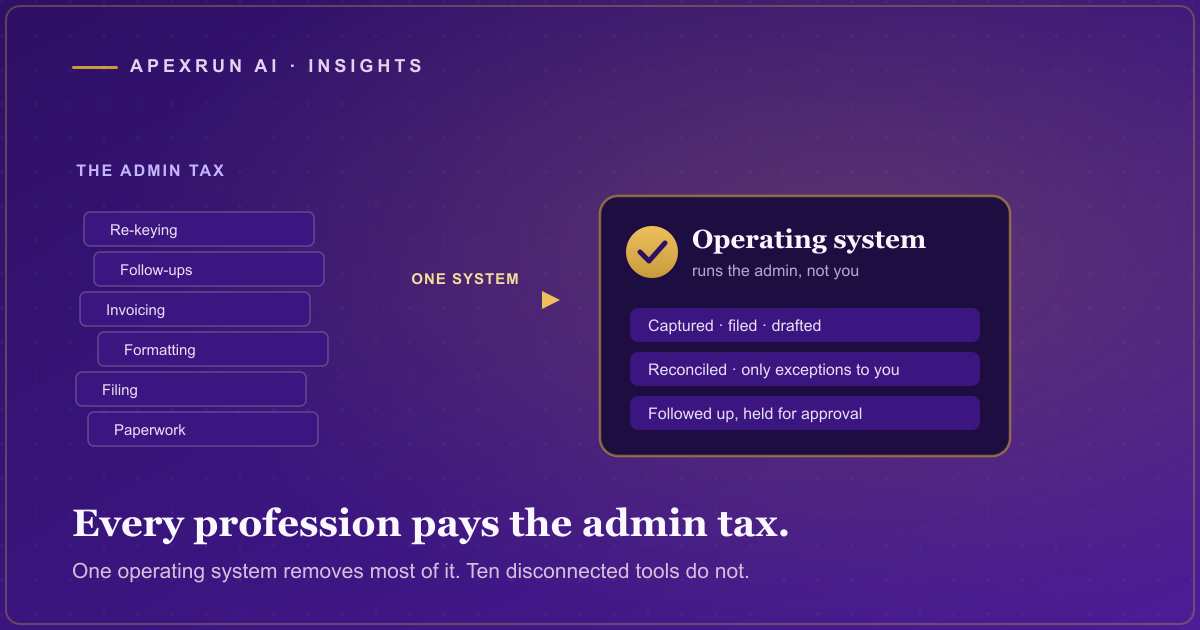
The same logic runs across every profession, which is the point of an AI operating system: it is not a tool that speeds up one task, it is a layer that takes recurring work off the whole operation so the recovered time can compound. The industries breakdown shows where those recurring blocks hide in each kind of business, and the pattern is identical everywhere: the biggest returns come from the boring, repetitive work that shows up every week, precisely because that is the work whose savings compound the hardest.
What this means for you
Look at your own week and find the category of work that behaves like my content did: recurring, repetitive, necessary, and not actually requiring your specific judgment. It might be intake and follow-up, scheduling, invoicing, reporting, or the same handful of messages you send over and over. Whatever it is, that is where your hidden month-per-year is sitting, and it is the first block to move onto a system.
Do not chase the biggest one-time saving. Chase the recurring one, because that is the one that compounds. Take it off your plate, reinvest the recovered hours into the next process, and let the flywheel do the rest. Five hours a week to one hour a month was not a single clever trick. It was one recurring block moved onto a system, and then the discipline to keep going.
The fastest way to find your version of that block is the Free CEO Audit. In one hour, direct with the decision-maker, we walk through where your recurring hours actually go, identify the one that will compound hardest when a system carries it, and hand you a prioritized plan, so you know exactly which block to move first before you spend a dollar building anything.