Most people think about AI as a one-time upgrade. You buy the tool, you save some hours, you settle into a slightly faster version of the same business. That framing badly undersells what is happening, and it is why so many owners feel no urgency. The real AI competitive advantage for a small business is not a single bump in efficiency. It is a flywheel, and the businesses that started turning it are pulling away from the ones that have not, faster than the laggards can see.
A flywheel is a heavy wheel that is hard to move at first and then, once it is spinning, stores momentum and gets easier to push. That is exactly what happens when a business starts automating the right work. The first push is the hardest. Every push after that is easier, and the wheel spins faster on its own.
How the efficiency flywheel actually turns
Here is the loop, concretely.
You automate one painful, repetitive process. Say it is your invoicing and follow-up, and it gives you back five hours a week. So far this is just a time saving, the thing everyone pictures. But watch what happens next.
Those five hours do not evaporate. You spend them on something that grows the business: closing two more clients, tightening your delivery, or building the next automation. Suppose you spend a slice of them wiring up automated client onboarding. Now onboarding runs itself too, and it hands you back another four hours. You are now eight or nine hours a week lighter than you were, and you have two processes running without you.
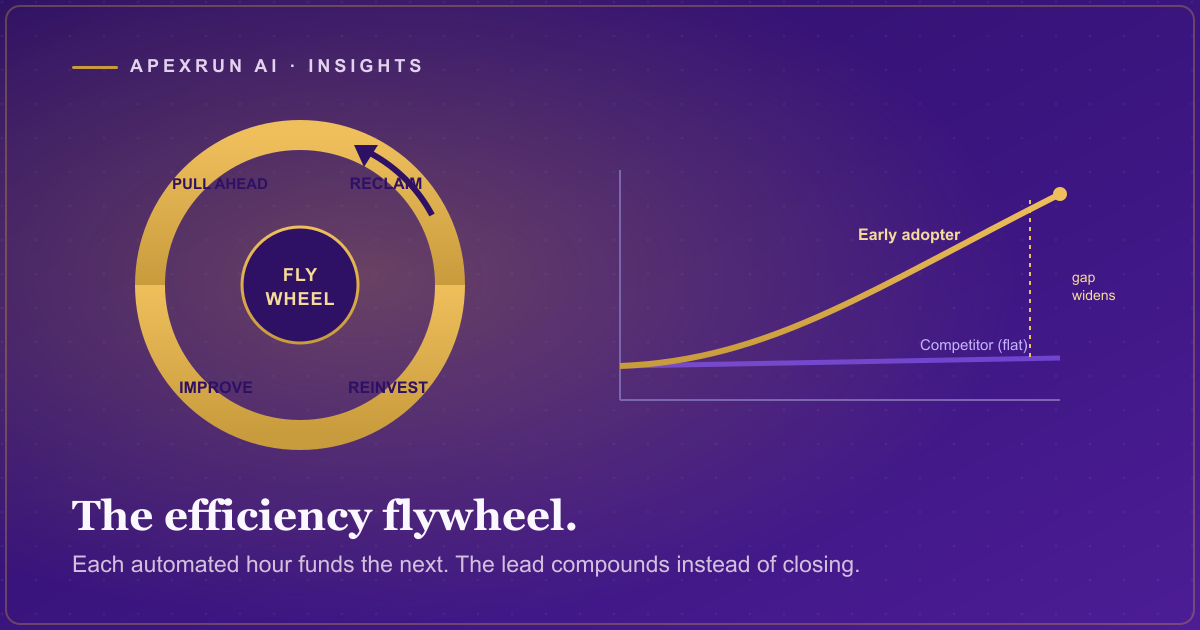
Round three, you point some of that reclaimed time at your reporting, or your lead nurture, or your intake. Each automated process frees hours. Each freed hour funds the next improvement. The wheel is turning on its own now, and it is speeding up. That is the flywheel: reclaim, reinvest, improve, pull ahead, repeat. The output of each turn is the fuel for the next.
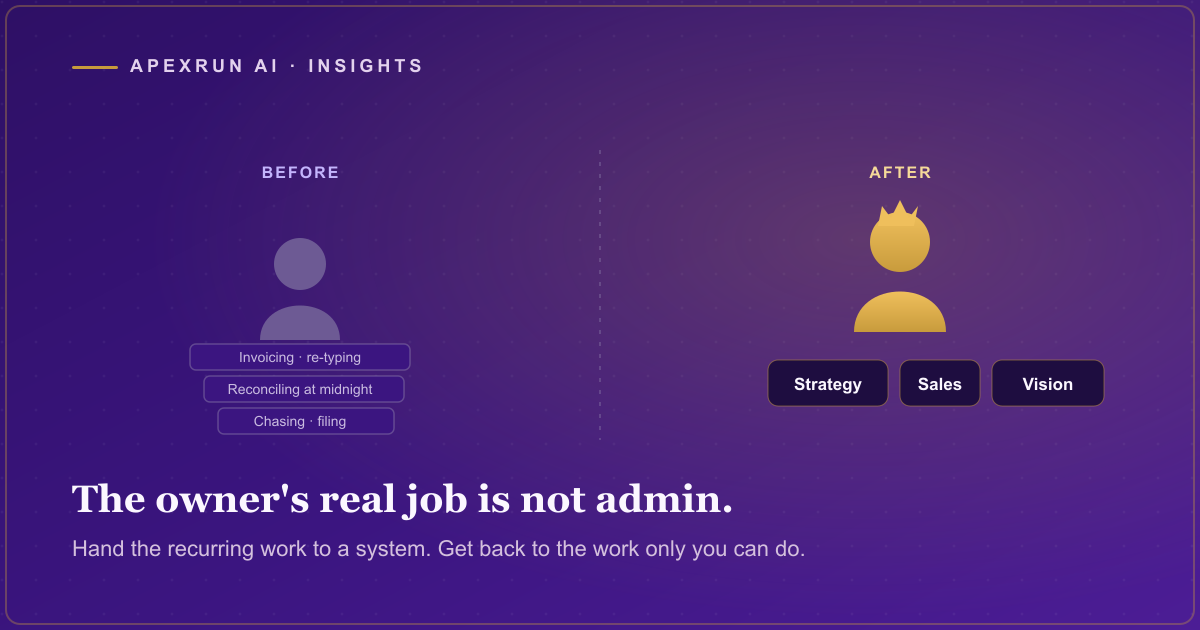
The business that never starts stays flat. Same hours, same ceiling, same owner buried in the same admin next year. Not because they are less capable, but because they never got the wheel moving, so they have no stored momentum to spend.
Why the gap widens instead of closing
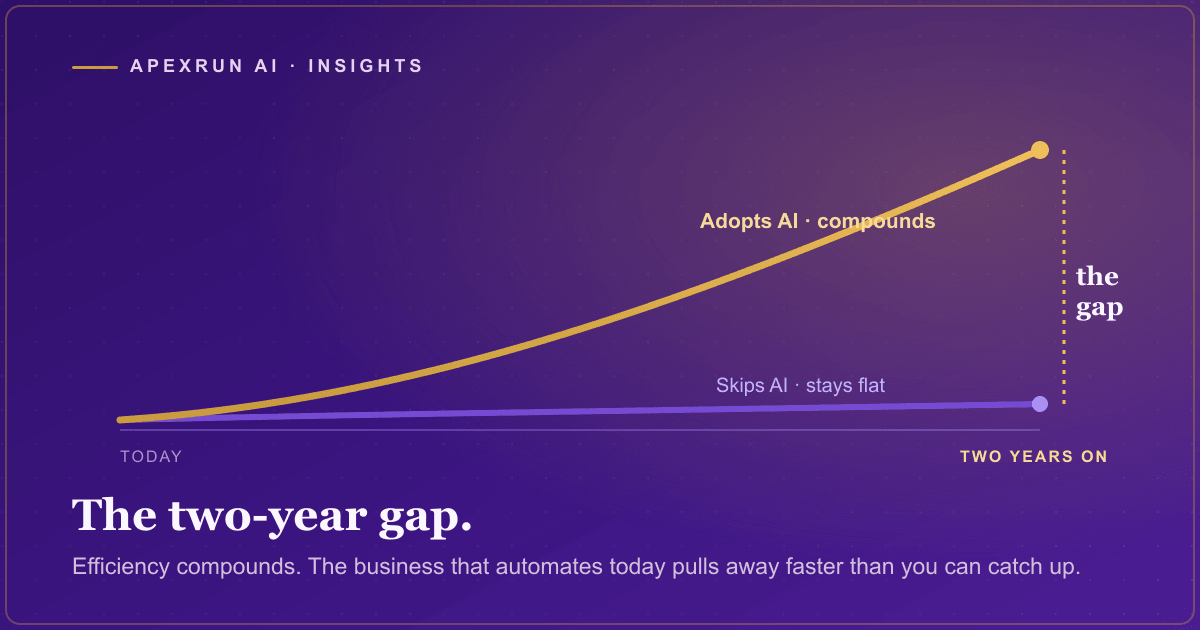
The intuition that trips owners up is the belief that they can catch up later. “AI is not going anywhere. I will get to it when things calm down.” The problem is that the lead an early adopter builds is not a fixed distance you can close with a sprint. It is compounding, and compounding gaps do not wait for you.
Think about two businesses in the same market. One started turning the flywheel a year ago. The other is planning to start. The early adopter is not just a year of tools ahead. They are a year of reinvested hours ahead, which means a year of extra clients served, extra processes built, extra margin banked, and extra learning about what to automate next. Every one of those advantages funds the next. By the time the second business starts pushing their cold, heavy wheel, the first one is spinning fast and using its momentum to move further still.
This is the part that should create urgency. The cost of waiting is not zero, and it is not a flat “you missed some savings.” It is the compounding lead your competitor is building with the hours you are still spending by hand. This is the same argument I made in the two-year gap, viewed through the machinery that makes the gap open: it is a flywheel, not a staircase.
The trap that stalls the wheel before it starts
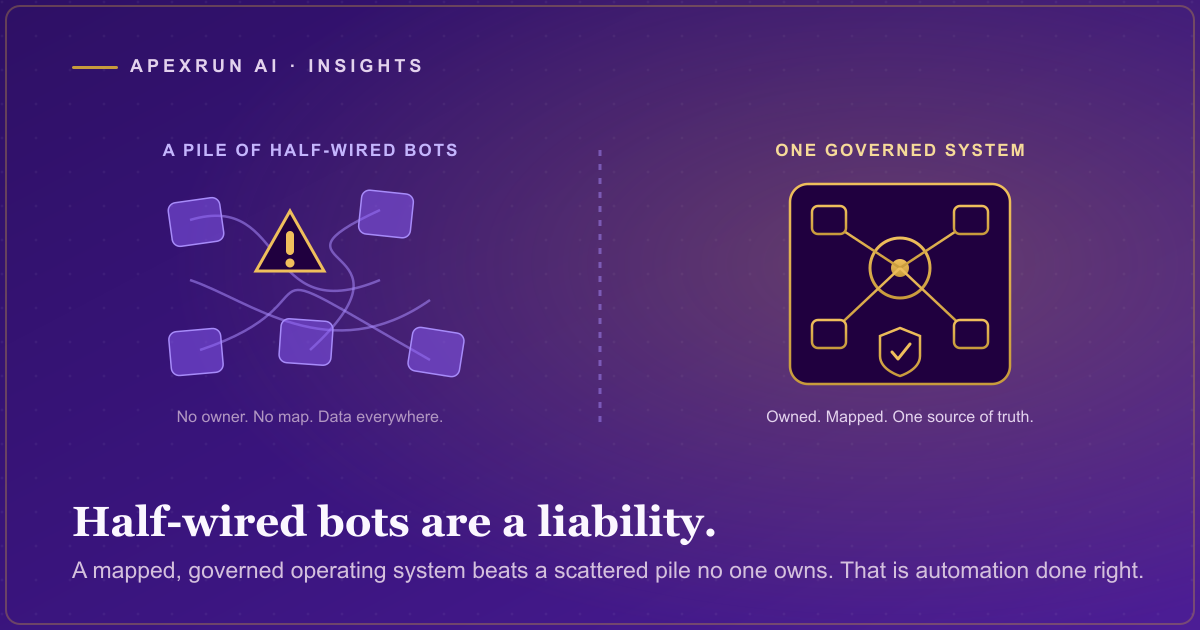
There is a way to do this badly that leaves owners convinced the flywheel is a myth. They buy twelve disconnected AI gadgets, wire none of them together, and end up managing more chaos than they started with. The wheel never gains momentum because each tool solves one task and creates two new ones around it. That is not a flywheel, it is a shed full of parts.
The flywheel only turns when the automations connect into a system, an operating system for the business rather than a drawer of apps. When your invoicing knows about your delivery, and your delivery feeds your reporting, and your reporting informs your outreach, the reclaimed hours stack instead of leaking away in the seams between disconnected tools. Coherence is what lets momentum accumulate. You can see how those connected pieces fit together on our packages page, and the reason the whole beats the sum of the parts is the entire point of an operating system.
What the flywheel looks like across a real business
This is not abstract. The same loop runs in a law firm that automates intake and reinvests the hours into billable work, in an accounting practice that automates reconciliation and redeploys the time to advisory, in a clinic that automates its front desk and uses the freed staff attention on patient care. The vertical changes, the flywheel does not. Each turn in any industry follows the same shape: reclaim hours, reinvest them into growth or the next automation, widen the lead.
And here is the quietly powerful part. Every turn also teaches you what to automate next. You learn where your real bottlenecks are only by clearing the first ones. The early adopter is not just further ahead on tools and hours. They are further ahead on knowing their own business, because the flywheel surfaces the next constraint each time it clears the last one. That knowledge is the hardest advantage to copy.
Start the wheel before the gap gets uncatchable
The honest takeaway is not that AI is impressive. It is that efficiency compounds, and compounding rewards whoever starts first. The best time to start turning the flywheel was a year ago. The second-best time is before your competitor builds a lead you cannot close by working harder, because you cannot out-hustle a compounding advantage with raw hours. That is the whole problem it creates.
You do not start by buying tools. You start by finding the one process whose automation frees the most hours the fastest, so the first push gives you the most momentum to reinvest. That is the highest-impact first turn of the wheel, and it is different for every business.
That first turn is exactly what the Free CEO Audit finds. In one hour, direct with the decision-maker, we map your operation, identify the automation that pays back fastest, and hand you a prioritized plan, so your first push puts the most momentum into the flywheel. Get the wheel moving now, while it is still yours to get ahead on.