Every owner I talk to has the same relationship with social media: guilt. They know they should post. They know consistency compounds. And they know that the last time they posted was three weeks ago, in a burst, because a competitor’s feed made them feel behind. The reason almost nobody manages to automate social media content business-wide is not laziness and it is not a lack of tools. It is that they bought a scheduler when what they needed was a system. A scheduler holds the posts you already wrote. It does nothing about the fact that writing them, approving them, and remembering to do it at all still lands entirely on you.
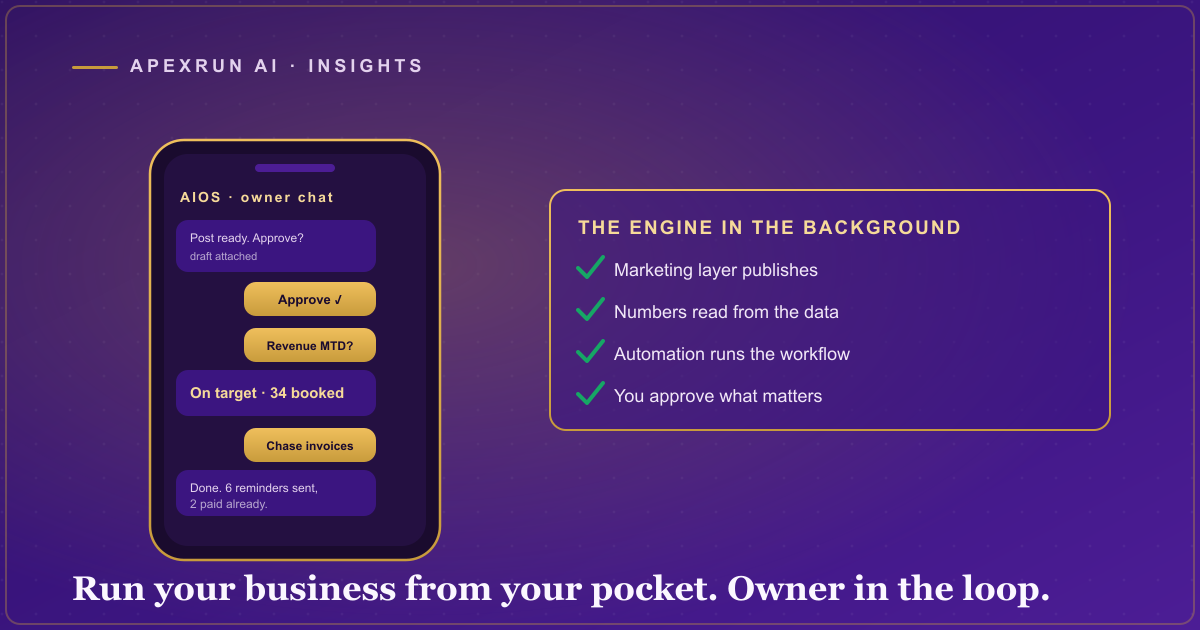
The marketing layer inside an AI operating system is a different animal. It does not wait for you to hand it finished content. It runs the whole loop, from blank page to posted, and loops you in only at the one point where your judgment actually matters.
What it means to automate social media content business-wide, properly
Let me define the thing precisely, because the phrase gets used loosely. To automate social media content for a business is not to schedule three posts you sweated over on a Sunday. It is to make the recurring work of showing up online happen on its own, at a quality you are happy to put your name on, without you being the engine that drives every step.
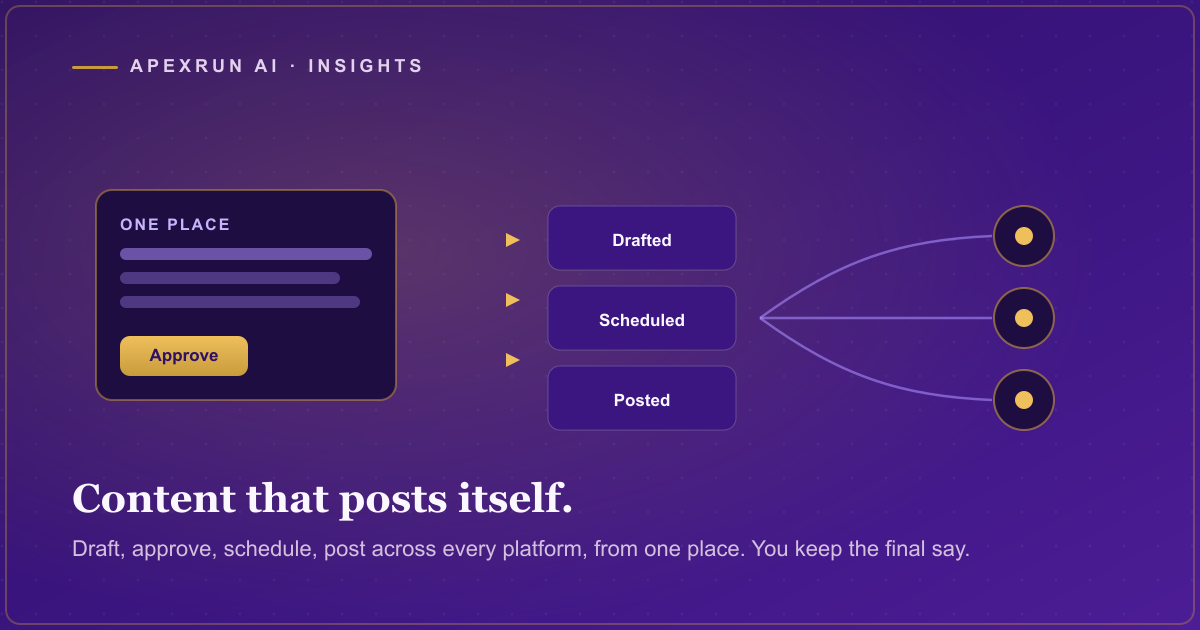
That loop has four stages, and most owners only ever automate the last one. The stages are draft, approve, schedule, and post. You can buy a tool for scheduling and posting in about five minutes. The two stages nobody solves are the first two, and they are the two that actually eat your week. Drafting is the blank-page tax. Approval is the bottleneck, because even when something else writes the draft, it still needs a human who knows the business to say yes. The AIOS marketing layer is built to carry all four, with the approval stage designed around you rather than around a junior marketer you have to hire and brief.
One place, not eleven tabs
Here is the part that changes the daily experience. Right now, if you are trying to be consistent, your marketing lives in a scatter of places. A notes app for ideas. A document for drafts. A design tool for images. A separate scheduler for each platform, or one scheduler you keep forgetting the password to. Your content does not fail because any one of these is bad. It fails because the seams between them are where the work dies. Every handoff is a place to stall, and you stall at all of them.
The marketing layer collapses that into a single surface. A post is drafted, shown to you with its image already attached, approved or edited in one click, and scheduled across every platform you care about, from the same place. You are not copying text from a document into five different apps and reformatting it for each one. You look at a queue, you approve what is good, you fix what is not, and the system does the distribution. The mental overhead of “where was that draft, which platform did I already post to, did the Tuesday one go out” simply stops existing. This is the same connected-flow principle that runs through the five layers of an AIOS: the value is not in any single task, it is in the seams being gone.
The approval gate is the whole point
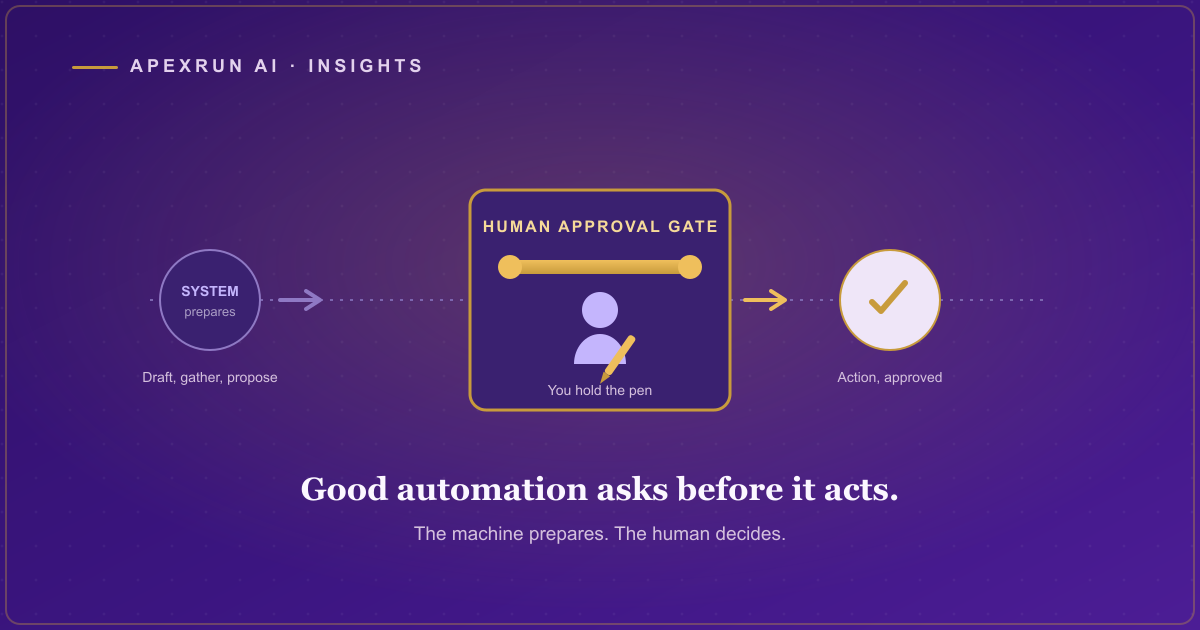
I want to be blunt about something, because the market is full of tools promising to post for you on full autopilot, and that is a bad idea for most businesses. Content that goes out with nobody looking at it is how you end up with a tone-deaf post during a bad news week, or a factual claim you would never have signed off on, sitting on your public feed with your name on it.
The AIOS marketing layer keeps a human approval gate in exactly the right place. The system does the labour: it drafts, it designs, it queues, it knows your platforms and your posting cadence. You do the judgment: does this sound like us, is this the right thing to say this week, is that claim one I stand behind. That division is the whole design. You are approving in seconds what would have taken you an hour to produce, but you are still the one who decides what represents the business. You get the leverage of automation without handing a stranger the keys to your voice. If you want the fuller picture of how this human-in-the-loop pattern runs across an operation, the what is an AIOS overview lays out where the gates sit and why.
Consistency without the daily grind
The reason consistency matters is not vanity metrics. It is that showing up steadily is what builds the familiarity that makes a prospect trust you before they ever call. The problem has always been that consistency depends on your willpower, and your willpower is spent on the actual business by Tuesday afternoon.
When the drafting and scheduling no longer depend on you finding a spare creative hour, consistency stops being a discipline problem and becomes a default. The queue is always populated. The approvals take minutes, not a dedicated block. A week where you are slammed is no longer a week where the feed goes silent, because the silence used to come from you being the bottleneck, and you are no longer the bottleneck. This is what people actually mean when they say they want to be consistent: they do not want to think about it every day, they want it handled and to keep the final say.
Where this fits for a business that sells on trust
For any business that wins clients on credibility, and most professional and service businesses do, a marketing presence is not decoration. It is the thing that makes you look like the obvious choice instead of a stranger. A digital agency lives or dies on this, but so does a clinic, a firm, or a trades company whose competitors have simply gone quiet. The marketing layer does not make you a content creator. It removes the reason you kept failing to be one.
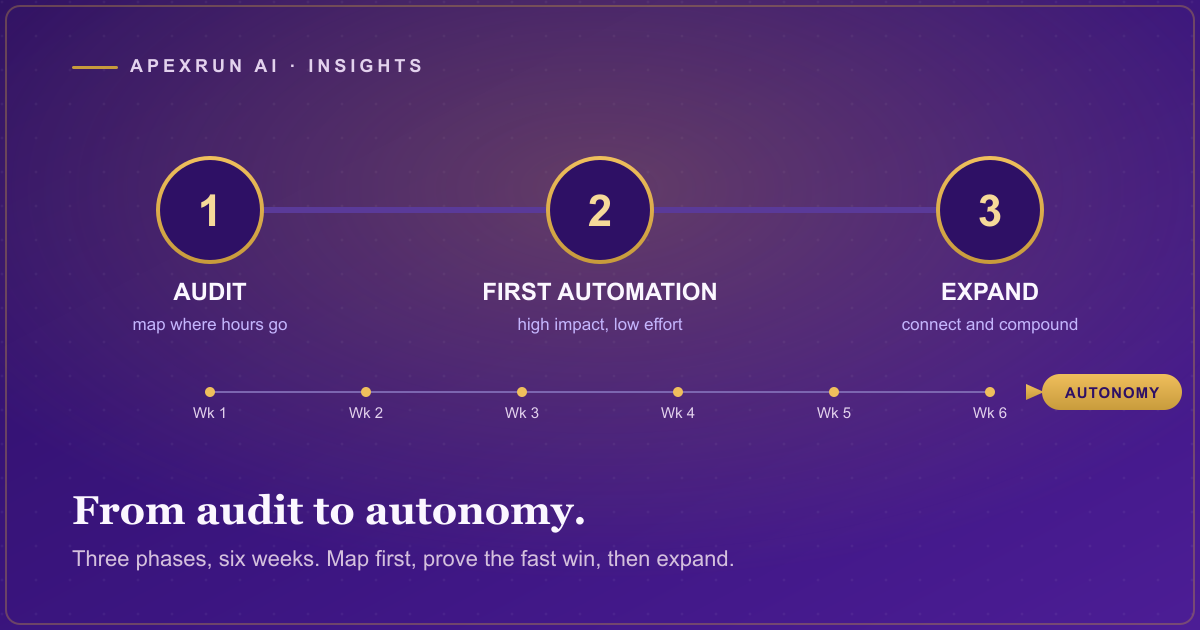
None of this is a reason to bolt a marketing tool onto a business that has no system underneath it. The marketing layer earns its keep as one part of a connected operation, which is exactly why the right first step is not buying software. It is figuring out where automation pays back fastest in your specific business, and in what order.
That is what the Free CEO Audit is for. In one hour, direct with the decision-maker, we map where your time and your consistency are actually leaking, and hand you a prioritized plan, so you build the layer that pays back first instead of the one that looked shiny. If the answer is that your marketing is the weak spot, you will know exactly what it would take to close it.