The single biggest reason owners stall on AI is not cost and it is not skepticism. It is that the whole thing feels like a black box. You know you should automate something, you have no idea what happens after you say yes, and nobody has walked you through it in plain terms. So you do nothing. Let me pull the cover off. The AI automation implementation process is not mysterious, and it is not a six-month enterprise slog. It starts with an audit and then runs in two phases, and the first meaningful result usually lands inside a couple of weeks.
The reason it works in phases matters. Every failed AI project I have seen tried to boil the ocean, automate everything at once, or bought a big platform and hoped the business would reshape itself around it. That is how you burn a budget and end up with a mess. The phased approach does the opposite. It earns trust with a fast win, then expands from proof, not from a pitch.
The AI automation implementation process: an audit, then two phases
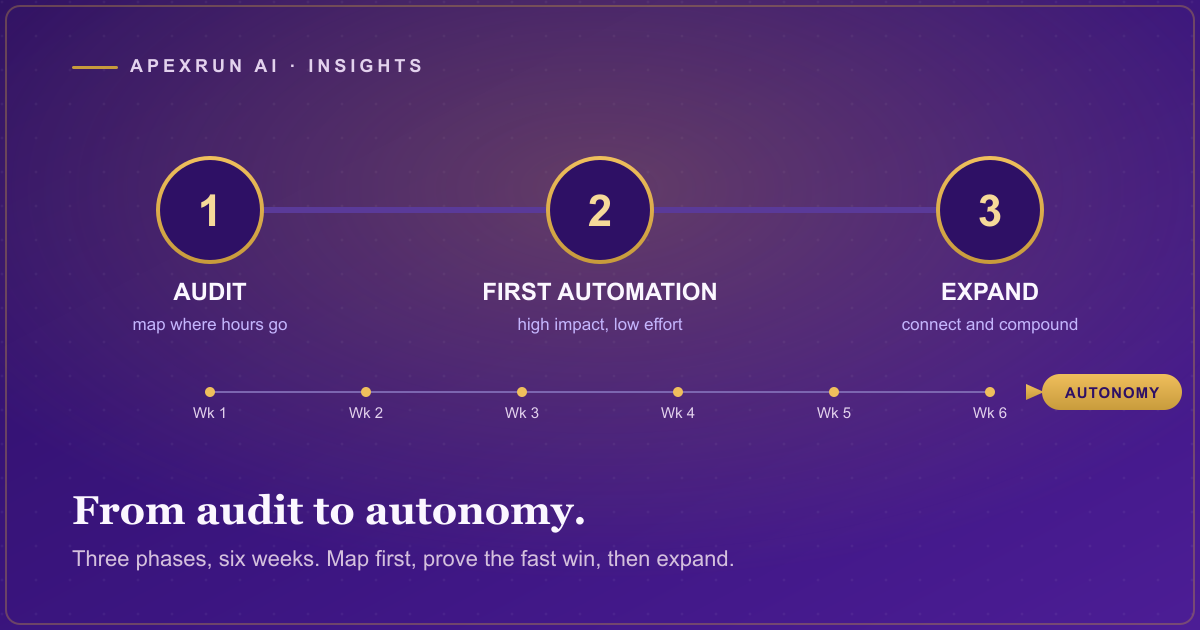
Step one: the audit. Before anything gets built, you map where the time and money actually go. Not where you assume they go, where they measurably go. Every recurring task, tagged by how much of your week it eats and how much value it carries. Out of that map falls a heat map of your operation: the high-cost, low-value work that is bleeding hours, and the handful of automations that would pay back fastest. Nothing gets built in this step. The output is a ranked plan, so you spend the first dollar on the right thing instead of the loudest thing.
Phase one: high impact, low effort first. You do not start with the hardest, most impressive automation. You start with the one that gives the most return for the least build. This is deliberate. The first automation’s real job is to prove the model works in your specific business and to reclaim the hours that fund everything after it. A fast, visible win, invoicing that runs itself, a front desk that stops dropping calls, reconciliation that clears in the background, builds the momentum and the trust to go further. You feel the difference in week one or two, not month six.
Phase two: expand. Once the first automation is running and proven, you connect the next one, and the next, each building on the foundation underneath it. This is where a collection of automations becomes an actual operating system: the invoicing knows about the delivery, the delivery feeds the reporting, the reporting informs the outreach. You expand in the order the audit ranked, highest payback first, so the system compounds instead of sprawling. If you want the deeper logic of what stacks on what, the five layers of an AI operating system explains why order is not decoration.
What weeks 1 through 6 actually look like
Enough theory. Here is a realistic timeline for a small business [ESTIMATED, varies by scope and readiness].
Week 1: the audit and the map. We sit with the decision-maker, walk the real workflow, and tag where the hours go. By the end of the week you have the heat map and a ranked plan. You know exactly what is getting built first and why.
Weeks 2 to 3: the first automation. The highest-payback, lowest-effort process gets built and wired into how you already work. This is the fast win. Somewhere in here you watch a task that used to eat your afternoons happen without you, with an approval gate wherever your judgment needs to stay in the loop.
Weeks 4 to 5: prove and tune. The first automation runs on real work. We watch it, tune the edge cases, and confirm it holds up under your actual volume, not a demo’s. You are now reviewing output instead of producing it, and the reclaimed hours are real and countable.
Week 6: expand. With one process proven and hours freed, the second automation goes in, chosen from the ranked plan. The flywheel starts turning. From here the pattern repeats: build, prove, expand, each turn funded by the last.
By the end of six weeks you are not “experimenting with AI.” You have a working piece of your business running itself, proof it works in your context, and a clear line of sight to the next several improvements. That is a very different place from where most owners sit, stuck at the black box.
Why the approval gates are the point, not a limitation
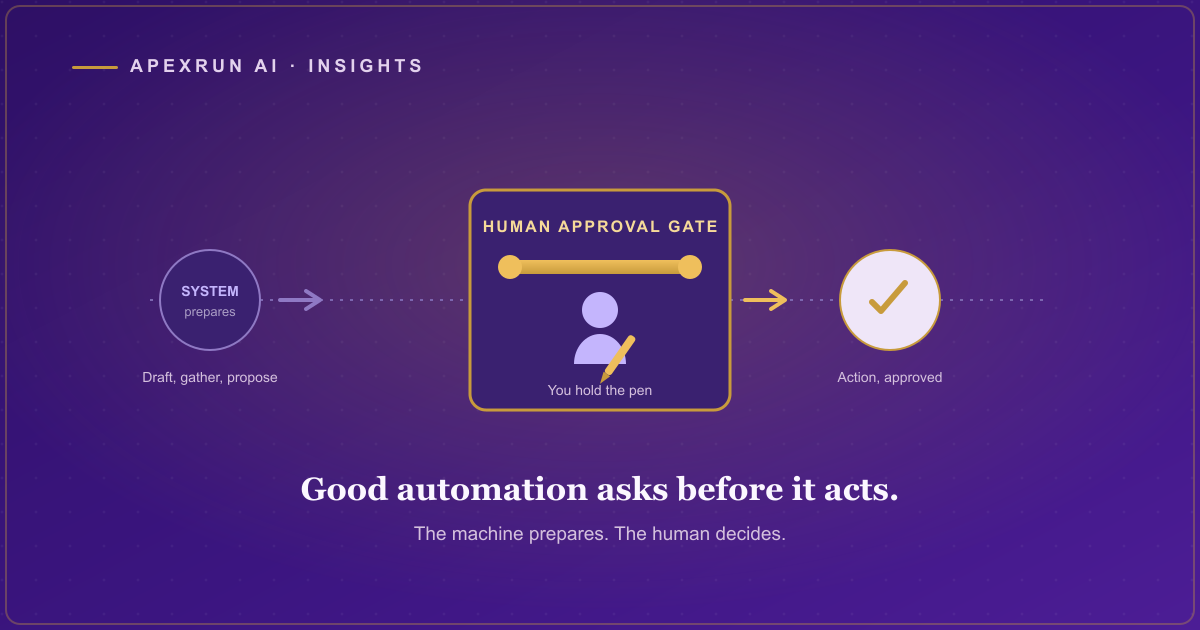
A fair worry about automation is that it will go off and do the wrong thing at scale. The phased process answers that directly. Automation only takes an action on its own where a mistake would be cheap and reversible. Anywhere a mistake would be costly, the system prepares the work and waits for a human to approve it. You are never handing the business to a machine that acts blindly. You are handing it repetitive preparation and keeping the judgment.
This is also why starting small matters beyond the fast win. Each phase earns the trust to widen the automation’s autonomy. The system proves it is right on low-stakes work before it is trusted with anything higher, which is exactly how you would onboard a sharp new hire. You do not give them signing authority on day one. You give it as they prove themselves.
The mistake that wastes the whole budget
The way this goes wrong is skipping the audit. Owners get excited, buy a tool or twelve, and start automating whatever is top of mind rather than what the map says pays back first. They end up with disconnected gadgets that never compound, and they conclude AI does not work. AI worked fine. They built with no plan, in no order, on no foundation. If you are still deciding whether an operating system even fits your business, what an AIOS is sets up the frame, and the packages page shows how the pieces connect once you are past the audit.
The whole process is built to remove that risk. Map first, build the fast win second, expand from proof third. No boiling the ocean, no big bet before a small proof, no dollar spent before the plan says where.
And it all starts with step one, which is exactly what the CEO Audit is. In one hour, direct with the decision-maker, we run the audit, hand you the heat map and the ranked plan, and show you precisely what weeks 1 through 6 would look like in your business, so you can decide with a real plan in front of you instead of a black box.