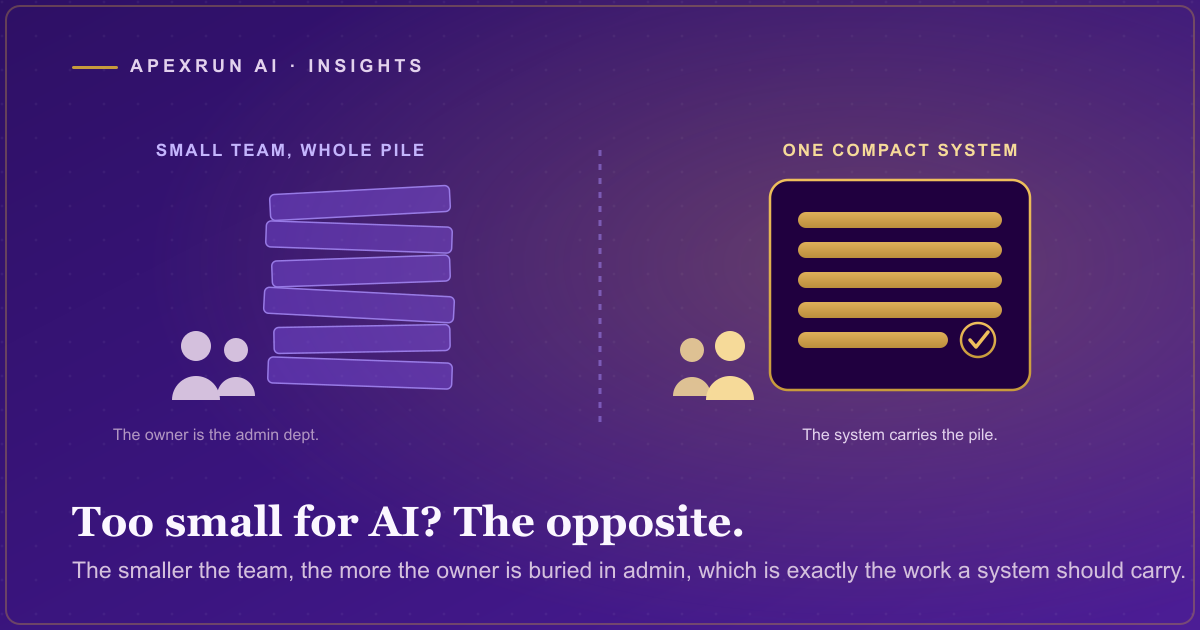
When an owner finally admits they are drowning in admin, the default fix that comes to mind is hiring an assistant. It is the obvious move, and sometimes it is the right one. But there is now a real alternative, an AI operating system, and the choice between them deserves an honest comparison rather than a sales pitch. AI vs a virtual assistant is not a case where one option wins on every axis. They win on different things, and knowing which is which is how you make the call correctly instead of defaulting to the familiar answer and paying for it later. So here is the straight version, including the places where the human genuinely beats the system.
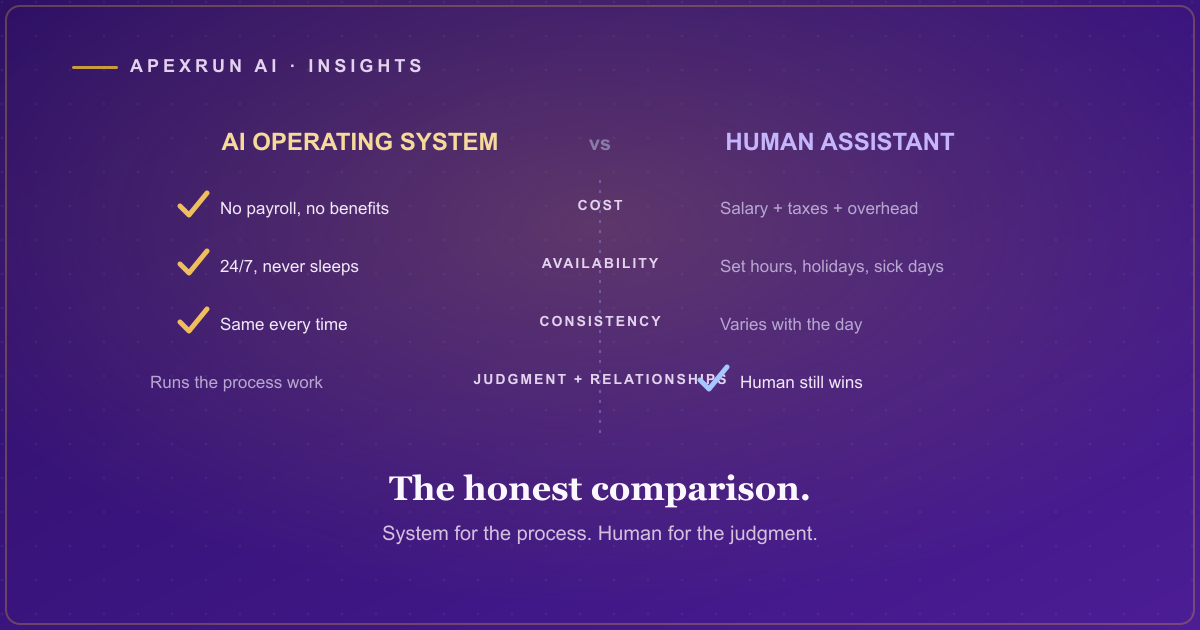
Cost: not close, and be honest about the full number
An assistant is not a salary, it is a salary plus everything around it. The wage, yes, but also payroll taxes, benefits, equipment, software seats, the time you spend recruiting and onboarding, and the ongoing management load of keeping someone directed and productive. A good assistant is worth all of it. But the true monthly cost is well above the number on the offer letter, and it is a fixed cost that shows up whether this month was busy or dead.
An AI operating system carries a different cost shape. There is a build and a running cost, but it does not come with payroll taxes, benefits, holidays, or the hidden management tax, and critically, its cost does not scale with the volume of work the way a second and third hire would. On the pure economics of running recurring admin, the system wins, and it is not particularly close. If your honest reason for not hiring is that you cannot justify the full loaded cost, the system is the option that was actually available to you all along.
Availability: the system does not sleep, and does not resent it
A human works their hours, takes lunch, goes on holiday, gets sick, and eventually leaves, taking everything they learned about how you work with them. None of that is a criticism, it is just being a person. But it means your coverage has gaps, and the busywork piles up in them.
An AI operating system runs at 2 AM, on the weekend, and through the holidays, at the same steady rate, without burning out or building resentment about the boring work. When a lead comes in at 9 PM, the system responds. When you need the report at 6 AM before a meeting, it is drafted. Availability is a clean win for the system, especially for the always-on tasks like lead response and follow-up where the value is entirely in the speed and the gaps are where you lose money.
Consistency: the system does the thousandth task like the first
People are variable, and that is true of the best of them. Attention drifts, a busy day means a step gets skipped, the follow-up that was sharp in week one gets perfunctory by month six. Humans are brilliant at judgment and mediocre at doing the identical repetitive task flawlessly forever, because that is genuinely soul-crushing work and nobody does it perfectly.
That is exactly the work a system is good at. It runs the follow-up cadence the same way every time, formats the report identically, never forgets the invoice, never gets bored of the routine because it does not experience boredom. For high-volume repetitive process, consistency favours the system, decisively. This is the same reason a drawer of disconnected tools fails while a coherent operating system holds, which I unpacked in AIOS vs ChatGPT: why a chatbot is not a system, the connected process is the thing that actually delivers consistency.
Scope: where the human still wins, and it matters
Now the honest other side, because a comparison that pretends the system wins everything is a sales pitch, not an analysis.
A human assistant brings things a system does not. Real judgment in a messy, ambiguous situation with no clean rule. Genuine relationship and warmth with a client who wants to feel known. Physical presence, walking a document down the hall, being in the room. The initiative to notice something is off that nobody thought to flag, and the discretion to handle a delicate human moment with care. When the work is relationship-heavy, judgment-heavy, physical, or genuinely novel every time, a good human assistant is worth more than any system, and it is not close in the other direction.
The mistake is treating this as an either-or war. The best-run small businesses do not choose the human or the system, they assign each to what it is actually good at. The system runs the high-volume, repetitive, always-on process work: the drafting, the follow-ups, the reporting, the intake, the scheduling. The human does the judgment, the relationships, and the genuinely novel problems. Used together, an assistant freed from the busywork by a system becomes far more valuable, because they spend their day on the human work instead of the data entry. The system does not replace the assistant so much as it upgrades the job.
The honest decision framework
Here is how to actually make the call. Write down the work you would hand to a new hire, and sort it into two piles. Pile one is repetitive, rule-based, high-volume, and time-sensitive: follow-ups, reports, invoicing, intake, scheduling, first drafts. Pile two is judgment, relationships, physical presence, and one-off problem-solving.
If the pile that is drowning you is mostly pile one, you do not need a hire, you need a system, and hiring a person to do pile-one work is paying a premium for something a system does better, cheaper, and around the clock. If the pile that is drowning you is mostly pile two, a system will not save you, and you should hire the human. Most owners, when they actually sort the piles, find their problem is overwhelmingly pile one, which is why they have been reluctant to hire, the full cost of a person never quite justified against work that did not really need a person. That reluctance was your instinct telling you the truth.
You can see how this split plays out concretely across the industries we work with, and how the process work gets bundled into one system on the packages page, rather than sold to you as a dozen tools you would then have to coordinate yourself.
Where to start
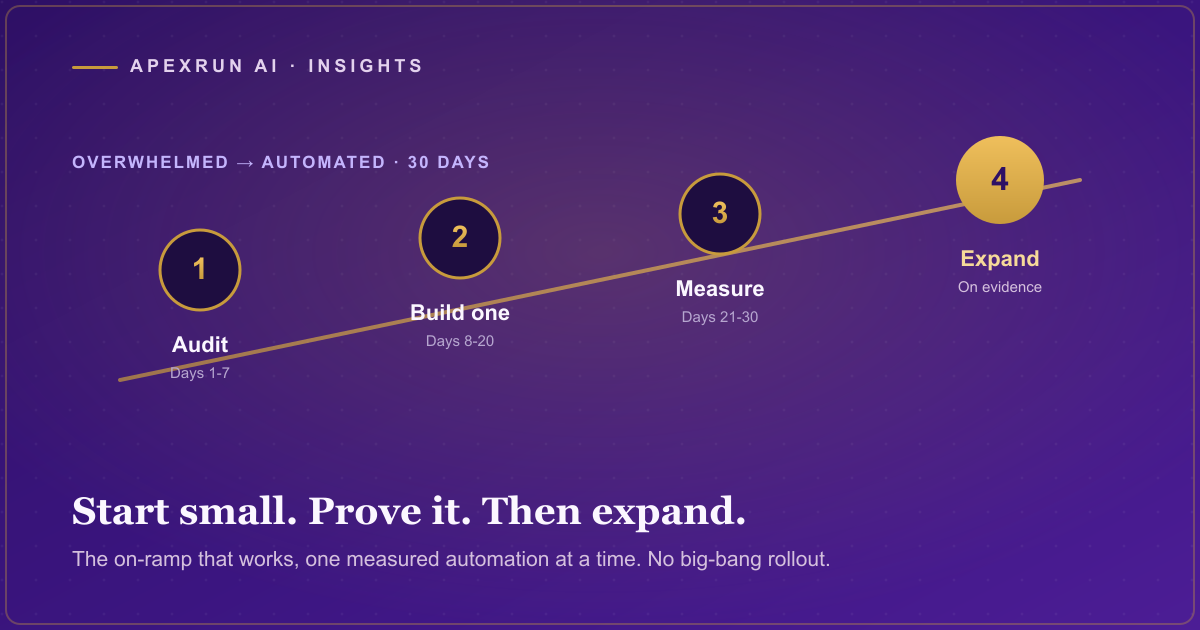
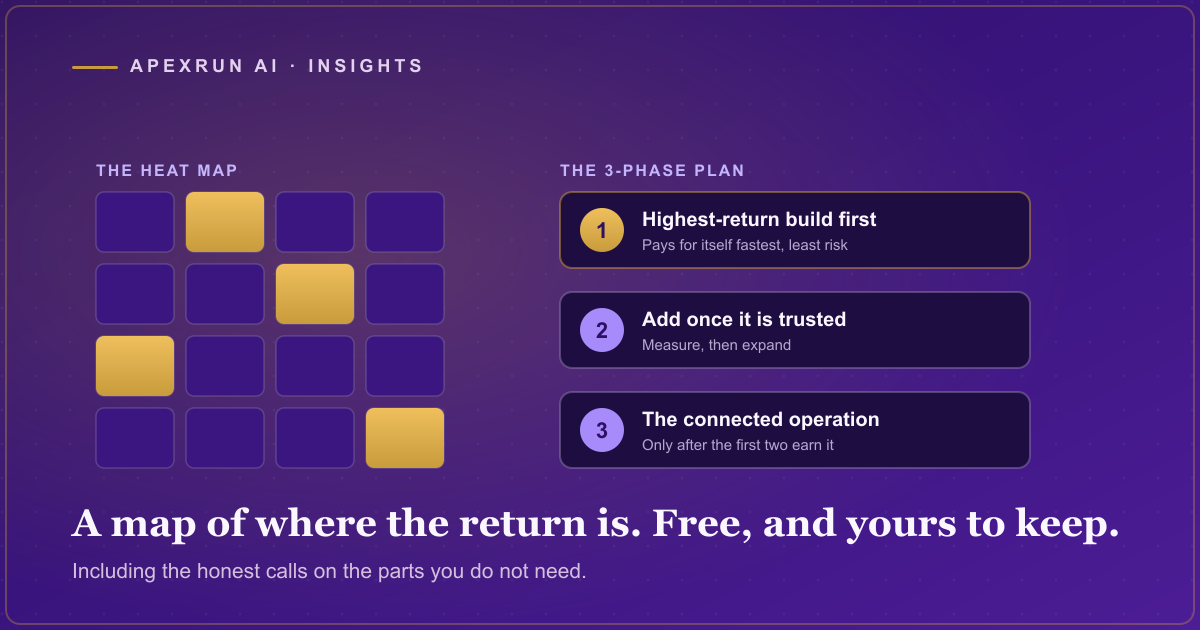
Do not make this decision from a brochure, yours or anyone’s. Make it from your own list of work. The Free CEO Audit does exactly that sort with you. In one hour, direct with the decision-maker, we map the work weighing you down, separate the pile a system should run from the pile a human should own, and hand you a prioritized plan, so you know precisely what to automate and what, if anything, to hire for, before you spend a dollar on either. The honest answer is usually a system for the process and a human for the judgment. The audit tells you where your specific line sits.