Insurance and wealth advisors sit in an awkward spot with this technology. The admin load is brutal, the case for automating it is obvious, and yet the compliance exposure makes most owners freeze, because a wrong move with client financial data is not a small mistake. AI for insurance advisors has to clear a bar that a lot of the popular tools simply do not: it cannot be a service somewhere in the cloud quietly ingesting your clients’ most sensitive information. If you are going to put a system near policy details, net worth, beneficiaries, and health disclosures, the first question is not what it can do. It is where the data goes.
That question has a clean answer, and it is the reason this can be done safely at all. The right build for a regulated practice runs on a local model, on hardware you control, so the sensitive information never leaves the office. That single design choice is what turns AI from a compliance risk into a compliance-safe tool, and it is where any serious conversation for an advisory practice has to start.
What AI for insurance advisors can actually take off your desk
Strip out the parts that need your licensed judgment and look at what is left in an advisor’s week. A huge share of it is structured, repetitive process work wrapped around client records, and that is exactly what a system is built to carry.
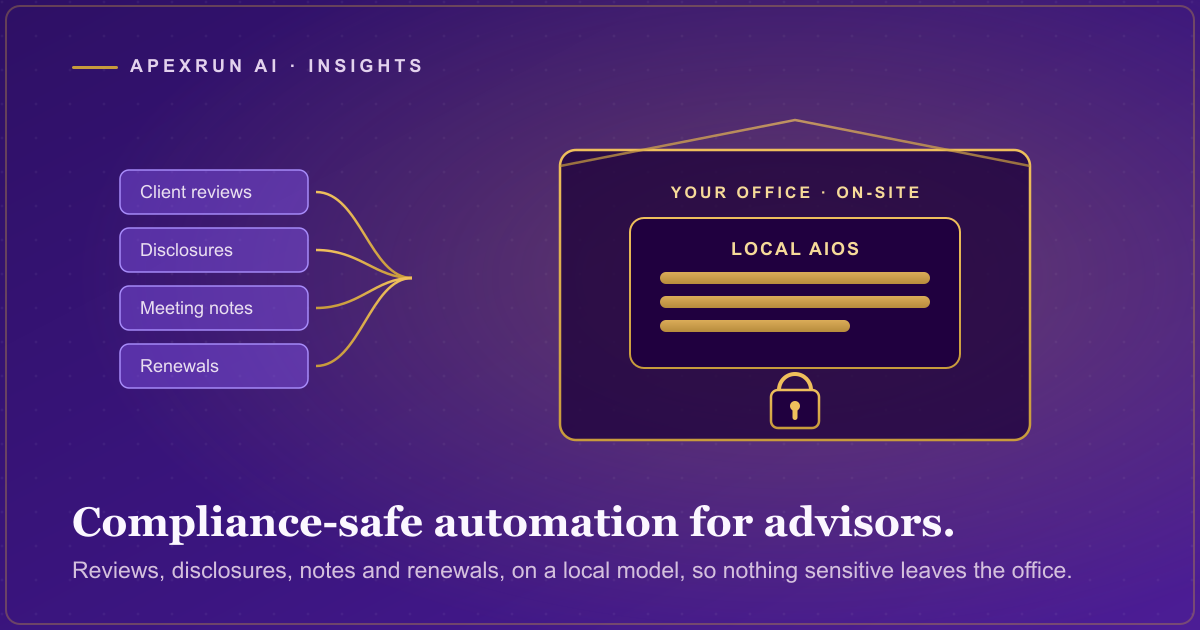
Client reviews. Preparing for an annual review means pulling the file, summarizing the client’s current position, flagging what has changed, and drafting the agenda. A system assembles the review pack from your own records so you walk in prepared instead of spending an hour reconstructing context you already had. You still run the review and give the advice. The machine just does the preparation.
Disclosures and documentation. Regulated practices live or die on documentation, and the volume of it is punishing. A system can draft the disclosure paperwork, populate the standard forms from the client record, and make sure the required documents are prepared and logged, so the paper trail is complete and consistent rather than reconstructed under pressure at review time.
Meeting notes. The follow-up after a client meeting is where a lot of advisors lose their evenings: writing up what was discussed, logging the decisions, updating the file, capturing the next actions. A system can turn the meeting into a clean, structured note against the client record, so the documentation is done while it is fresh and nothing gets lost between the meeting and the write-up.
Renewals. Renewals are pure timing and follow-through, and they are where revenue and coverage both leak when a busy advisor loses track. A system runs the renewal calendar, prepares the outreach, and keeps the cadence alive so policies do not lapse and reviews do not slip, which protects both the client’s coverage and the practice’s book.
The line that keeps it compliant: the system prepares, the advisor advises
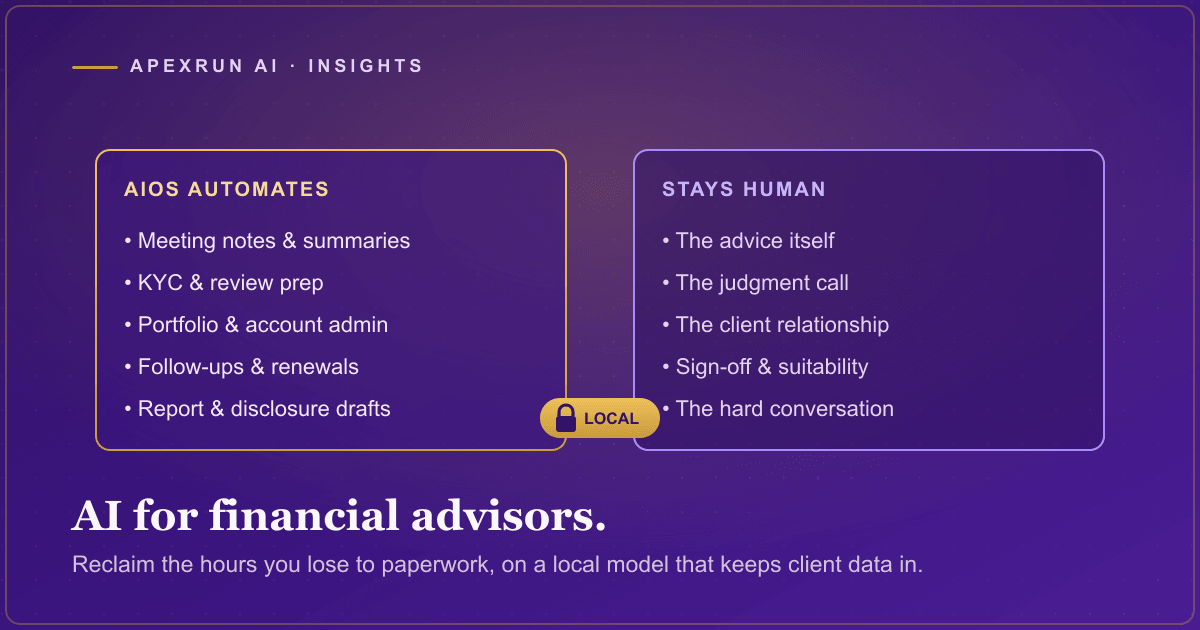
This is the non-negotiable part, and it is the same principle that governs every serious deployment. The system does not give advice, does not make a recommendation to a client, and does not send anything client-facing without your approval. The regulated judgment, the suitability call, the actual advice, stays entirely with the licensed human, because that is your job, your liability, and the thing the client is paying for.
What the system does is the preparation and the process around that judgment: assembling the review, drafting the documentation, structuring the notes, running the renewal timing. Every client-facing action sits behind an approval step, so nothing goes out that you have not seen and signed off. That is the human-in-the-loop discipline applied to a regulated practice, and in insurance and wealth it is not optional polish. It is the mechanism that keeps you compliant while still getting the hours back.
Why local is the whole point for a regulated practice
Most AI tools you can sign up for send your data to a provider’s cloud to be processed. For a lot of businesses that is a manageable trade. For an insurance or wealth practice handling clients’ financial and health information, it is often a dealbreaker, because you have obligations about where that data lives and who can touch it, and “we sent it to a third party’s servers to summarize” is not an answer you want to give a regulator or a client.
Running on a local model changes the equation. The processing happens on hardware in your office, the client information stays on-site, and you are not shipping sensitive records to someone else’s cloud to get the benefit. This is the same private-by-design approach that makes AI viable in any field where confidentiality is the product, and for advisors it is the difference between a tool you can actually adopt and one your compliance obligations rule out on day one. It is also, as it happens, the model that does not bleed money on per-record cloud fees, but for a regulated practice the privacy is the headline and the economics are the bonus.
Where to start in an advisory practice
Do not try to automate the whole practice at once. Start with the one process that costs you the most time and carries the least regulated judgment, which for most advisors is either the meeting-note write-up eating your evenings or the renewal follow-through leaking policies. Prove it on that, with the approval step firmly in place, and widen from there once you trust it.
The financial-advisors command book lays out how this maps to an advisory operation specifically, and the broader pattern of what an owned system runs is in what an AI operating system actually is. The through-line is the same for insurance and wealth as for any regulated field: the machine carries the structured process work, the local model keeps the sensitive data in the building, and the licensed advisor keeps every ounce of the judgment.
The way to find your safest, highest-value first step is the Free CEO Audit. In one hour, direct with the decision-maker, we walk through where your hours actually go, identify which processes a compliance-safe system should carry first, and hand you a prioritized plan built around keeping client data on-site, so you know exactly what to turn on before you spend a dollar building it.