Ask a financial advisor why they got into the business and you will hear some version of the same answer: to help people make good decisions with their money and to build relationships that last decades. Ask them how they actually spent last Tuesday and you will hear something very different. Notes from three meetings, still not written up. A KYC refresh that took an hour of form-filling. A review pack assembled by hand. Renewal reminders. A compliance log. This is the gap AI for financial advisors is built to close: the distance between the work you trained for and the paperwork that quietly took over your calendar.
The paperwork is not optional and it is not going away. But almost none of it requires your licence or your judgment, which means almost none of it should be eating your billable, relationship-building hours.
The admin load an advisor’s week actually carries
Advisory work generates an enormous amount of documentation, and most of it lands on the advisor. Meeting notes have to be written up accurately and filed. Client onboarding means KYC and know-your-product paperwork, identity verification, risk profiling, and disclosures. Annual and periodic reviews mean assembling the client’s picture, drafting the summary, and preparing the materials. Portfolio and account administration generates a steady stream of forms, letters, and updates. On top of all of it sits the record-keeping and compliance trail that regulators expect you to maintain.
None of this is glamorous and all of it is necessary. The trouble is that it scales directly with your book. The more clients you serve well, the more of these hours you owe, until the administrative tail is wagging the advisory dog and your capacity to take on new relationships is capped not by demand but by paperwork.
Walk through one review meeting to see how the load stacks. Before it, someone assembles the client’s current position and prepares the pack. During it, you are listening and advising, but also mentally logging what needs to be captured. After it, the notes get written up, the file gets updated, the action items get turned into tasks, and the follow-up gets sent. The forty-five minutes of actual advice sits inside two or three hours of surrounding administration, and every one of your clients is owed that cycle on a schedule. Multiply it across a full book and the arithmetic explains exactly why your evenings disappear.
What an AI operating system automates, and what stays human
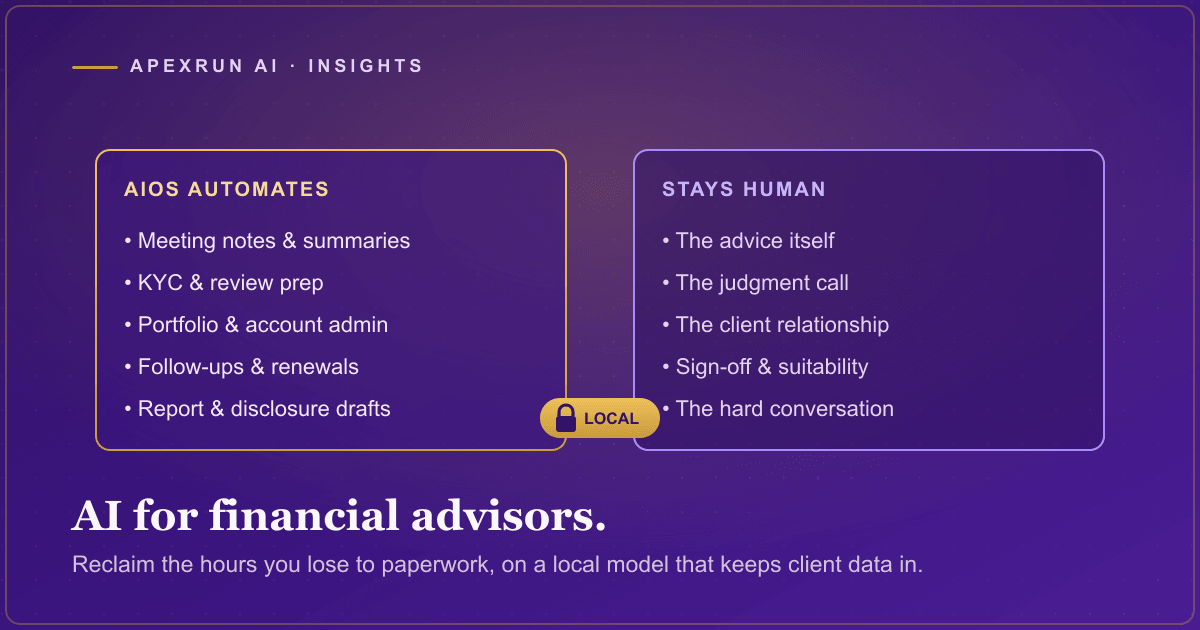
Here is the line that matters, because it is the one advisors are right to worry about. An AI operating system takes on the production of the paperwork. It does not take on the advice. Those are two different things, and keeping them separate is the whole discipline of doing this well.
On the automate side: the system drafts your meeting notes from a recording or your dictation, structured and filed, ready for your review. It prepares the KYC and review packs, pulling the client’s information into the right format and flagging what is missing or due. It drafts the periodic review summary so you are editing a near-complete document instead of building one from a blank page. It handles the follow-up cadence, the renewal reminders, and the routine client communications. It keeps the record trail current. This is the recurring, template-shaped work that fills your evenings, and it is exactly what a system is good at.
On the human side, nothing moves. The advice itself, the suitability judgment, the recommendation, the sign-off, and the relationship stay entirely with you. Every output the system produces is a draft that waits for your review and approval before it goes anywhere or gets relied upon. The automation sits behind an approval gate at every point where a mistake would carry a consequence, which in an advisory practice is most points. You are reviewing and deciding, not producing from scratch. That is the shift: from doing the paperwork to signing off on it.
Done this way, the tool never makes a regulated decision. It removes the clerical labour around the decision so you have the time and the clear head to make the decision well.
The compliance angle that changes everything: it can run locally
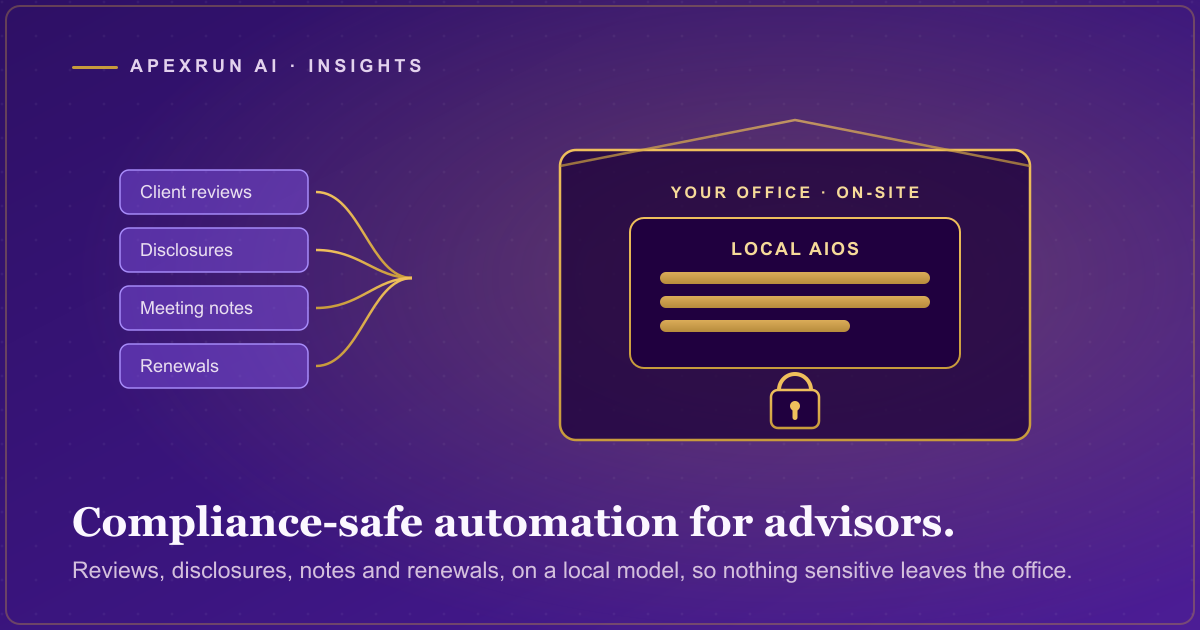
There is a specific reason advisors have been right to hesitate with the mainstream AI tools, and it is not caution for its own sake. Client financial data is some of the most sensitive information there is, and you carry real obligations to protect it and to keep proper custody of it. Pasting a client’s financial picture into a public, cloud-based AI tool sends that data offshore to a server you do not control, which is a genuine problem rather than a hypothetical one.
An AIOS does not have to work that way. It can run on a local model, on hardware inside your own office, so the client data never leaves the building and never crosses a border into a US data centre. You get the automation without creating the exposure. For a regulated practice, that is the detail that turns AI from something you keep at arm’s length into something you can actually deploy, a point worth reading in full in the case for local AI. The efficiency was always attractive. The data residency is what makes it safe.
What reclaiming those hours is actually worth
Do the arithmetic on your own practice. If the administrative tail is taking even fifteen hours a week off you, and a system absorbs the bulk of it, you are getting most of a working day back every week. That time does not disappear into more admin. It goes to the two things that actually grow an advisory practice: serving your existing clients better and building new relationships. At an advisor’s economics, that reclaimed capacity is not a rounding error. It is the difference between a book you are barely keeping up with and a practice you are deliberately growing.
The practical first step is to see where your specific hours are going and which of them a system can safely take. The scorecard built for advisory practices is a fast way to gauge that fit, and it lives on our financial advisors page.
When you are ready to map it properly, the Free CEO Audit does exactly that for your practice: one hour, direct with you, identifying the paperwork an AI operating system can lift off your plate, how to keep it compliance-safe and local, and a prioritized plan for what to automate first. You leave knowing precisely how many hours you can get back and what they are worth.