None of these are stupid decisions. That is what makes them expensive. Each one looks correct at the time.
1. Buying tools instead of fixing a process
The most common one by a distance.
You buy a tool. It is genuinely good. Six months later you are paying for it and nobody uses it, because the process it was supposed to improve never changed.
The tool was never the missing piece. The missing piece was deciding how the work should actually flow, and no software makes that decision for you.
Instead: write down the process first. If you cannot write it down, that is the project. Automating an undefined process produces an undefined result, faster.
2. Starting with the most complicated thing
The biggest problem is the most tempting place to start, and the worst.
Complicated processes have exceptions, and exceptions are where automation projects die. You spend the whole budget on edge cases and never get to the part that pays.
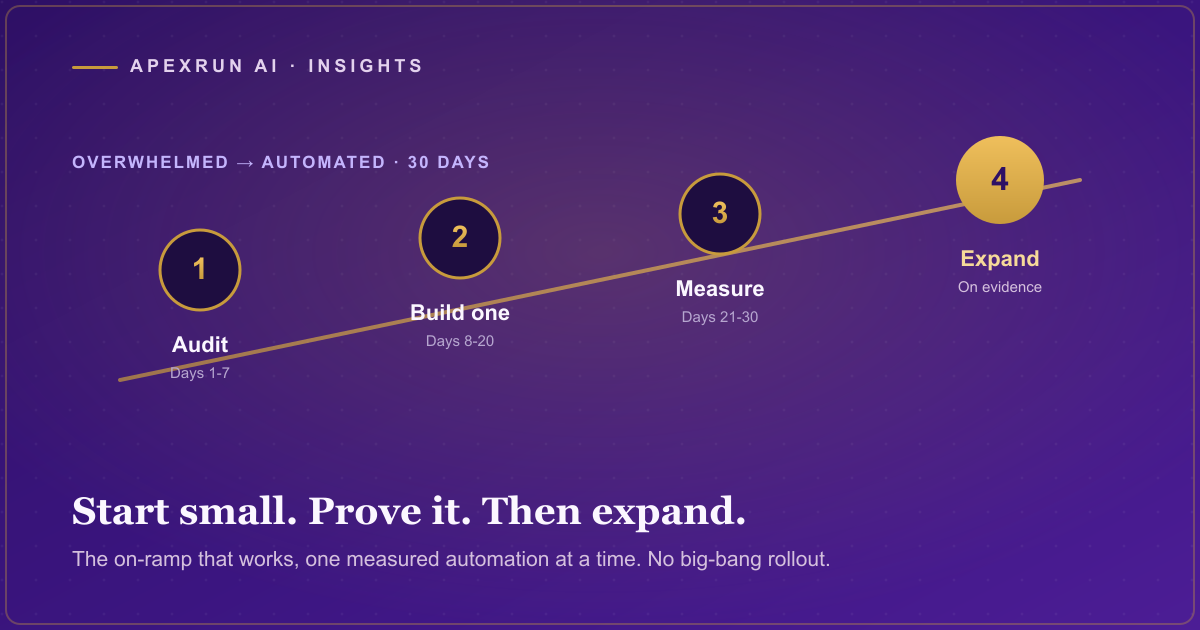
Instead: start with something frequent, consistent and recoverable when wrong. Get it working, build trust in it, then use that trust on something harder.
3. Automating something that should be deleted
Some tasks do not need doing faster. They need to stop.
Reports nobody reads. Approvals for things nobody would refuse. A form that exists because someone asked for it in 2019. Automating these makes them permanent, because now there is a system depending on them.
Instead: for every process on your list, ask what happens if this simply stopped. You will find at least one where the honest answer is nothing.
4. Letting it act before you trust it
There is a strong pull toward full autonomy, because that is where the savings look biggest.
The problem is that a system acting unsupervised on day one will be wrong somewhere, and you will find out from a customer. That costs more than the automation saved, and it poisons the team against the next attempt.
Instead: run it drafting for a human to approve, first. Watch what it produces for a couple of weeks. Where it is consistently right, let it act. Where it is not, you have just avoided a problem.
5. Nobody owning it
The system goes live. The person who set it up moves on. Something changes in the business. The system keeps doing what it was told, which is now wrong.
Nobody notices for a month, because it does not error. It just quietly does the wrong thing.
Instead: somebody has to own it, and that ownership needs a specific trigger. When we change prices, someone checks the system. When we add a service, someone checks. Put it on a real list.
The one underneath all five
Every one of these comes from the same place: treating this as a technology purchase rather than an operations decision.
The technology is the easy half now, and it gets easier every quarter. The hard half is knowing what should happen, who decides, and what to do when it is wrong. That has not got easier, and no tool is going to do it for you.
A cheap check
Look at whatever you bought in the last year for this. Ask three things.
Is it being used by the people it was for. Did the underlying process actually change. Would anyone notice if it were switched off tomorrow.
If the answer to the third is no, you have found something to stop paying for. That is a real saving and it takes an afternoon to find.